
Ch.20 - Nuclear Chemistry
McMurry - Chemistry 8th Edition
McMurry8th EditionChemistryISBN: 9781292336145Non è quello che usi tu?Cambia libro di testo
Capitolo 20, Problema 119

Polonium-210, a naturally occurring radioisotope, is an alpha emitter, with t1/2=138 d. Assume that a sample fo 210Po with a mass of 0.700 mg was placed ina 250.0-mL flask, which was evacuated, sealed, and allowed to sit undisturbed. What would the pressure be inside the flask (in mmHg) at 20 degrees Celsius after 365 days if all the alpha particles emitted has become helium atoms?

Guida verificata passo dopo passo
1
Step 1: Calculate the number of moles of 210Po initially present using the formula: \( n = \frac{mass}{molar\ mass} \). The molar mass of 210Po is approximately 210 g/mol.
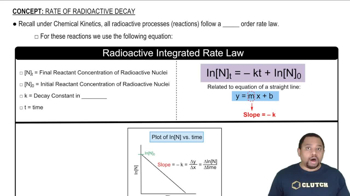
Step 2: Determine the number of moles of 210Po remaining after 365 days using the decay formula: \( n_t = n_0 \times e^{-\lambda t} \), where \( \lambda = \frac{\ln(2)}{t_{1/2}} \) and \( t_{1/2} \) is the half-life of 210Po.
Step 3: Calculate the number of moles of 210Po that have decayed by subtracting the moles remaining from the initial moles: \( n_{decayed} = n_0 - n_t \).
Step 4: Since each decay of 210Po produces one helium atom, the moles of helium produced will be equal to the moles of 210Po that have decayed.
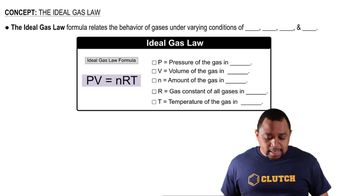
Step 5: Use the ideal gas law to calculate the pressure of the helium gas formed. The formula is \( P = \frac{nRT}{V} \), where \( n \) is the number of moles of helium, \( R \) is the gas constant (0.0821 L atm K^{-1} mol^{-1}), \( T \) is the temperature in Kelvin, and \( V \) is the volume of the flask in liters.

Risposta video verificata per un problema simile:

Questa soluzione video è stata consigliata dai nostri tutor come utile per risolvere questo problema.
Durata del video:
14m

Concetti chiave

Ecco i concetti essenziali che devi comprendere per rispondere correttamente alla domanda.

Radioactive Decay

Radioactive decay is the process by which unstable atomic nuclei lose energy by emitting radiation. In the case of Polonium-210, it undergoes alpha decay, releasing alpha particles that can transform into helium atoms. Understanding the half-life, which is the time required for half of the radioactive substance to decay, is crucial for calculating the remaining amount of Polonium-210 after a given period.
Video consigliato:
Percorso guidato
03:00
Rate of Radioactive Decay

Ideal Gas Law

The Ideal Gas Law relates the pressure, volume, temperature, and number of moles of a gas through the equation PV = nRT. In this scenario, after the decay of Polonium-210 into helium, the produced helium gas will exert pressure in the sealed flask. Knowing the volume of the flask and the temperature allows us to calculate the pressure exerted by the helium using the number of moles produced from the decay.
Video consigliato:
Percorso guidato
01:15
Ideal Gas Law Formula

Molar Mass and Stoichiometry

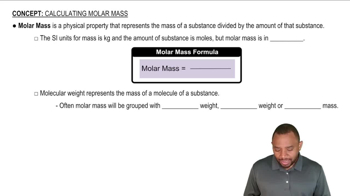
Molar mass is the mass of one mole of a substance, which is essential for converting between grams and moles. In this problem, we need to determine how many moles of helium are produced from the decay of the initial mass of Polonium-210. Stoichiometry allows us to relate the amount of Polonium-210 that decays to the amount of helium produced, which is necessary for calculating the final pressure in the flask.
Video consigliato:
Percorso guidato
02:11
Molar Mass Concept
Pratica correlata
Domanda del libro di testo
Imagine that you have a 0.007 50 M aqueous MgCl2 solu-tion, prepared so that it contains a small amount of radio-active 28Mg. The half-life of 28Mg is 20.91 h, and the initial activity of the MgCl2 solution is 0.112 mCi>mL. Assume that 20.00 mL of this MgCl2 solution is added to 15.00 mL of 0.012 50 M aqueous Na2CO3 solution and that the resultant precipitate is then removed by filtration to yield a clear filtrate. After a long break to go for a run, you find that the activity of the filtrate measured 2.40 h after begin-ning the experiment is 0.029 mCi>mL. What are the molar concentrations of Mg2+ and CO32- in the filtrate, and what is the solubility product constant of MgCO3?
330
views
Domanda del libro di testo
A small sample of wood from an archaeological site in Clo-vis, New Mexico, was burned in O2 and the CO2 produced was bubbled through a solution of Ba(OH)2 to produce a precipitation of BaCO3. When the BaCO3 was collected by filtration, a 1.000 g sample was found to have a radioactivity of 4.0 x 10^-5 Bq. The half-life of 14C is 5715 y, and living organisms have a radioactivity due to 14C if 15.3 disintegrations/min per gram of carbon. If the analysis was carried out in 1960, what is the date of the Clovis site?
313
views
Domanda del libro di testo
A proposed nuclear theory suggests that the relative abun-dances of the uranium isotopes 235U and 238U were approximately equal at the time they were formed. Today, the observed ratio of these isotopes is 7.25 x 10^-3. Give that the half-lives for radioactive decay are 7.04 x 19^8 are y for and 4.47 x 10^9 y for , calculate the age of the elements.
308
views