Ch.20 - Nuclear Chemistry
McMurry - Chemistry 8th Edition
McMurry8th EditionChemistryISBN: 9781292336145Non è quello che usi tu?Cambia libro di testo
Capitolo 20, Problema 26

Positron emission and electron capture both give a product nucleus whose atomic number is 1 less than the starting nucleus. Explain.

Guida verificata passo dopo passo
1
Understand that both positron emission and electron capture are types of nuclear reactions that involve changes in the nucleus of an atom, specifically affecting the protons and neutrons within the nucleus.
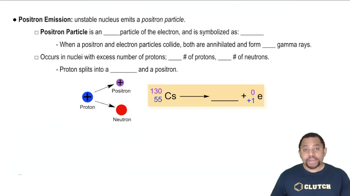
Recognize that a positron is the antimatter counterpart of an electron, having the same mass but a positive charge. In positron emission, a proton in the nucleus is transformed into a neutron, releasing a positron and a neutrino. This process decreases the atomic number by 1 because the proton count decreases by one.
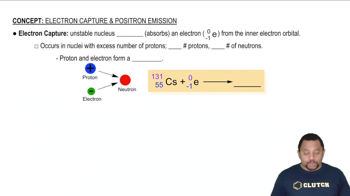
Identify that in electron capture, an electron from the atom's inner shell is captured by the nucleus where it combines with a proton to form a neutron and emits a neutrino. Similar to positron emission, this process reduces the atomic number by 1 due to the conversion of a proton into a neutron.
Note that in both processes, the mass number (total number of protons and neutrons) of the nucleus remains the same, but the atomic number (number of protons) decreases by one. This results in the formation of a new element that is one position left on the periodic table from the original element.
Conclude that the key similarity in both positron emission and electron capture is the transformation of a proton into a neutron, leading to a decrease in the atomic number by one, thus forming a new element with similar mass but different chemical properties.

Risposta video verificata per un problema simile:

Questa soluzione video è stata consigliata dai nostri tutor come utile per risolvere questo problema.
Durata del video:
3m

Concetti chiave

Ecco i concetti essenziali che devi comprendere per rispondere correttamente alla domanda.

Nuclear Reactions

Nuclear reactions involve changes in an atom's nucleus, resulting in the transformation of one element into another. In positron emission and electron capture, the nucleus undergoes a process that alters its composition, specifically the number of protons and neutrons, leading to the formation of a different element.
Video consigliato:
Percorso guidato
02:06
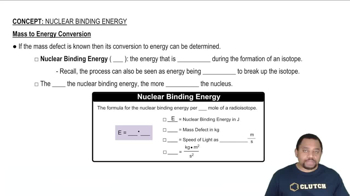
Nuclear Binding Energy

Positron Emission

Positron emission is a type of beta decay where a proton in the nucleus is converted into a neutron, releasing a positron (the antimatter counterpart of an electron) and a neutrino. This process decreases the atomic number by one, resulting in a new element that is one position to the left on the periodic table.
Video consigliato:
Percorso guidato
01:53
Positron Emission

Electron Capture

Electron capture occurs when an inner orbital electron is captured by the nucleus, where it combines with a proton to form a neutron and a neutrino. This reaction also reduces the atomic number by one, leading to the formation of a new element, similar to positron emission, but through a different mechanism.
Video consigliato:
Percorso guidato
01:26
Electron Capture