Ch.20 - Nuclear Chemistry
McMurry - Chemistry 8th Edition
McMurry8th EditionChemistryISBN: 9781292336145Non è quello che usi tu?Cambia libro di testo
Capitolo 20, Problema 50

The half-life of indium-111, a radioisotope used in studying the distribution of white blood cells, is t1/2 = 2.805 days. What is the decay constant of 111In?

Guida verificata passo dopo passo
1
Understand that the decay constant (\( \lambda \)) is related to the half-life (\( t_{1/2} \)) of a radioactive isotope by the formula: \( \lambda = \frac{\ln(2)}{t_{1/2}} \).
Identify the given half-life of indium-111, which is \( t_{1/2} = 2.805 \) days.
Use the natural logarithm of 2, which is approximately 0.693, in the formula for the decay constant.
Substitute the given half-life into the formula: \( \lambda = \frac{0.693}{2.805} \).
Perform the division to find the decay constant \( \lambda \) in units of days^{-1}.

Risposta video verificata per un problema simile:

Questa soluzione video è stata consigliata dai nostri tutor come utile per risolvere questo problema.
Durata del video:
2m

Concetti chiave

Ecco i concetti essenziali che devi comprendere per rispondere correttamente alla domanda.

Half-life

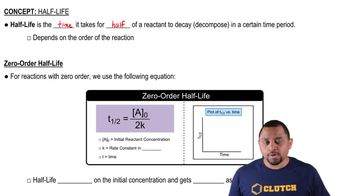
Half-life is the time required for half of the radioactive nuclei in a sample to decay. It is a crucial concept in nuclear chemistry, as it helps determine the stability and longevity of a radioactive isotope. For indium-111, a half-life of 2.805 days indicates that after this period, half of the original amount of the isotope will have transformed into a different element or isotope.
Video consigliato:
Percorso guidato
02:17
Zero-Order Half-life

Decay constant

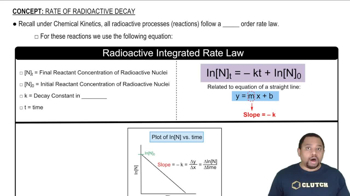
The decay constant (λ) is a probability rate at which a radioactive substance decays. It is related to the half-life by the equation λ = ln(2) / t1/2. This constant provides insight into the rate of decay, with a larger decay constant indicating a faster decay process. Understanding the decay constant is essential for calculating the remaining quantity of a radioactive substance over time.
Video consigliato:

Radioactive decay

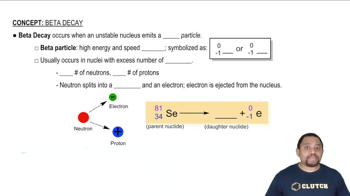
Radioactive decay is the process by which an unstable atomic nucleus loses energy by emitting radiation. This can occur in various forms, including alpha, beta, and gamma decay. The study of radioactive decay is fundamental in nuclear chemistry, as it explains how isotopes like indium-111 transform into more stable forms over time, impacting their applications in medical imaging and treatment.
Video consigliato:
Percorso guidato
03:00
Rate of Radioactive Decay