
Ch.20 - Nuclear Chemistry
McMurry - Chemistry 8th Edition
McMurry8th EditionChemistryISBN: 9781292336145Non è quello che usi tu?Cambia libro di testo
Capitolo 20, Problema 110

The maximum level of radon in drinking water is 4.0 pCi (4.0 x 10^-12Ci) per milliliter. (a) How many disintegrations occur per minute in 1 mL of water at the maximum radon level? (b) If the radioactive isotope is 222Rn(t1/2 = 3.8 days), how many 222Rn atoms are present in 1 mL of the water?

Guida verificata passo dopo passo
1
Step 1: Convert the half-life of 222Rn from days to minutes. Since there are 1440 minutes in a day, multiply the half-life in days by 1440 to get the half-life in minutes.
Step 2: Use the decay constant formula, \( \lambda = \frac{\ln(2)}{t_{1/2}} \), where \( t_{1/2} \) is the half-life of the radionuclide. Substitute the half-life in minutes to find the decay constant, \( \lambda \).
Step 3: Calculate the activity (A) of radon in the water using the formula \( A = \lambda \times N \), where \( N \) is the number of radon atoms. Rearrange the formula to solve for \( N \) as \( N = \frac{A}{\lambda} \).
Step 4: Use the given maximum radon level in the water (4.0 pCi/mL) as the activity (A) to find the number of radon atoms (N) in 1 mL of water using the decay constant calculated in Step 2.
Step 5: To find the number of disintegrations per minute, use the activity directly, as the activity in curies (or picocuries) represents the number of disintegrations per second. Convert this to disintegrations per minute by multiplying by 60 seconds.

Risposta video verificata per un problema simile:

Questa soluzione video è stata consigliata dai nostri tutor come utile per risolvere questo problema.
Durata del video:
9m

Concetti chiave

Ecco i concetti essenziali che devi comprendere per rispondere correttamente alla domanda.

Radioactive Decay

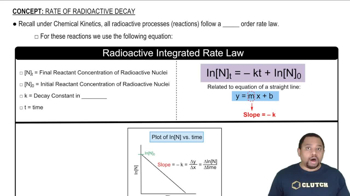
Radioactive decay is the process by which unstable atomic nuclei lose energy by emitting radiation. This decay occurs at a characteristic rate for each isotope, defined by its half-life, which is the time required for half of the radioactive atoms in a sample to decay. Understanding this concept is crucial for calculating the number of disintegrations and the amount of radioactive material present in a given volume.
Video consigliato:
Percorso guidato
03:00
Rate of Radioactive Decay

Disintegration Rate

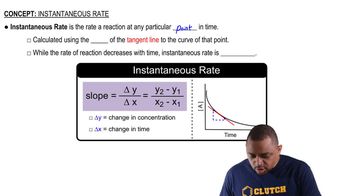
The disintegration rate, often measured in disintegrations per minute (dpm) or curies (Ci), quantifies the number of radioactive decays occurring in a sample over a specific time period. In this context, the maximum level of radon in drinking water is given in picocuries, which can be converted to disintegrations per minute using conversion factors. This rate is essential for determining the activity of the radon in the water sample.
Video consigliato:
Percorso guidato
01:30
Instantaneous Rate

Avogadro's Number

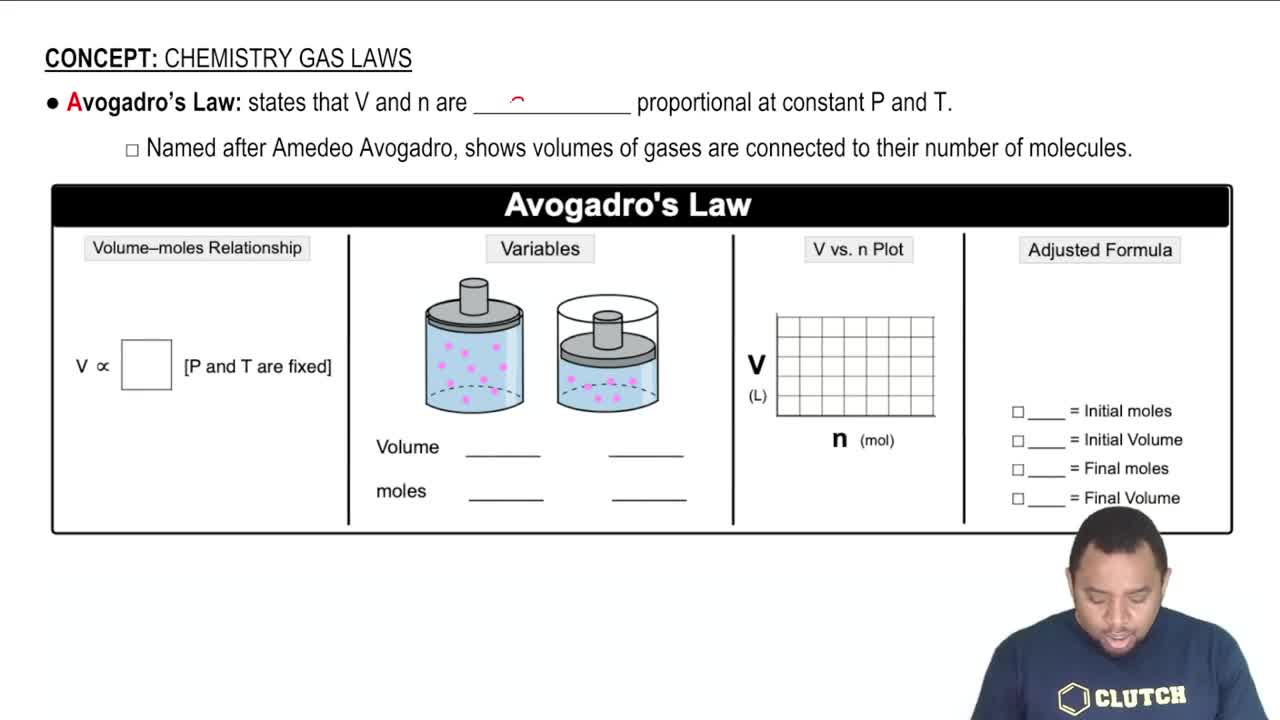
Avogadro's number (approximately 6.022 x 10^23) is the number of atoms, ions, or molecules in one mole of a substance. This concept is vital for converting between the number of disintegrations per minute and the number of atoms present in a sample. By using the disintegration rate and the half-life of the isotope, one can calculate the total number of radon atoms in the specified volume of water.
Video consigliato: