Ch.20 - Nuclear Chemistry
McMurry - Chemistry 8th Edition
McMurry8th EditionChemistryISBN: 9781292336145Non è quello che usi tu?Cambia libro di testo
Capitolo 20, Problema 35b

What particle is produced in each of the following decay reactions? (b)

Guida verificata passo dopo passo
1
Identify the type of decay reaction given in the problem. Common types include alpha decay, beta decay, and gamma decay.
For beta decay, determine if it is beta-minus (β-) or beta-plus (β+) decay. Beta-minus decay involves the conversion of a neutron into a proton, while beta-plus decay involves the conversion of a proton into a neutron.
Write the nuclear equation for the decay process. For beta-minus decay, the equation is: \( _{Z}^{A}X \rightarrow _{Z+1}^{A}Y + \beta^- + \bar{\nu}_e \). For beta-plus decay, the equation is: \( _{Z}^{A}X \rightarrow _{Z-1}^{A}Y + \beta^+ + \nu_e \).
Identify the particle produced in the decay reaction. In beta-minus decay, the particle produced is a beta particle (\( \beta^- \)), which is an electron. In beta-plus decay, the particle produced is a positron (\( \beta^+ \)).
Verify the conservation of charge and mass number in the nuclear equation to ensure the reaction is balanced.

Risposta video verificata per un problema simile:

Questa soluzione video è stata consigliata dai nostri tutor come utile per risolvere questo problema.
Durata del video:
1m

Concetti chiave

Ecco i concetti essenziali che devi comprendere per rispondere correttamente alla domanda.

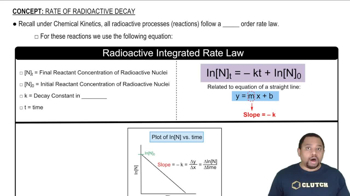
Radioactive Decay

Radioactive decay is a process by which an unstable atomic nucleus loses energy by emitting radiation. This can occur in various forms, including alpha particles, beta particles, and gamma rays. Understanding the type of decay is crucial for predicting the particles produced during the reaction.
Video consigliato:
Percorso guidato
03:00
Rate of Radioactive Decay

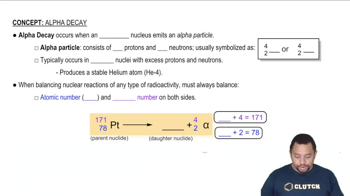
Alpha Decay

Alpha decay is a type of radioactive decay in which an atomic nucleus emits an alpha particle, consisting of two protons and two neutrons (essentially a helium nucleus). This process decreases the atomic number of the original element by two, resulting in the formation of a new element. Recognizing this helps in identifying the products of decay reactions.
Video consigliato:

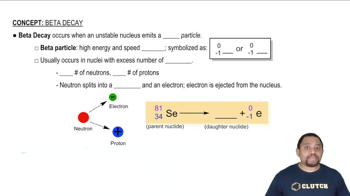
Beta Decay

Beta decay involves the transformation of a neutron into a proton (or vice versa) within an atomic nucleus, resulting in the emission of a beta particle (an electron or positron). This process changes the atomic number of the element, leading to the formation of a different element. Understanding beta decay is essential for determining the particles produced in decay reactions.
Video consigliato: