Ch.21 - Transition Elements and Coordination Chemistry
McMurry - Chemistry 8th Edition
McMurry8th EditionChemistryISBN: 9781292336145Non è quello che usi tu?Cambia libro di testo
Capitolo 21, Problema 74

(a) Identify the Lewis acid and the Lewis base in the reaction of ethylenediamine (H2NCH2CH2NH2) with Ni2+ to form [Ni(en)3]2+.
(b) Identify the ligands and donor atoms.
(c) Give the coordination number and geometry of the metal in the complex.

Guida verificata passo dopo passo
1
Identify the Lewis acid and Lewis base by determining which species donates an electron pair and which accepts it. In this reaction, the Ni2+ ion, which accepts electron pairs, is the Lewis acid, and ethylenediamine (H2NCH2CH2NH2), which donates electron pairs from its nitrogen atoms, is the Lewis base.
Determine the ligands in the complex. In this case, ethylenediamine acts as a ligand. Each ethylenediamine molecule has two nitrogen atoms that can donate electron pairs to the metal ion.
Identify the donor atoms within the ligands. For ethylenediamine, the donor atoms are the nitrogen atoms because they provide the lone pairs of electrons that coordinate with the metal ion.
Calculate the coordination number, which is the number of points at which ligands are attached to the metal ion. In [Ni(en)3]2+, each ethylenediamine provides two donor atoms, and there are three ethylenediamine ligands, leading to a total of six coordination sites being occupied.
Determine the geometry of the metal in the complex based on the coordination number. For a coordination number of six, the typical geometry is octahedral. Thus, the nickel ion in [Ni(en)3]2+ is surrounded octahedrally by the nitrogen atoms from the ethylenediamine ligands.

Risposta video verificata per un problema simile:

Questa soluzione video è stata consigliata dai nostri tutor come utile per risolvere questo problema.

Concetti chiave

Ecco i concetti essenziali che devi comprendere per rispondere correttamente alla domanda.

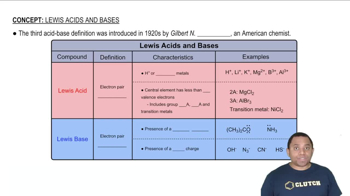
Lewis Acids and Bases

Lewis acids are species that can accept an electron pair, while Lewis bases are those that can donate an electron pair. In the given reaction, ethylenediamine acts as a Lewis base by donating its lone pair of electrons to the Ni2+ ion, which functions as a Lewis acid by accepting the electron pair to form a coordinate bond.
Video consigliato:
Percorso guidato
05:04
Lewis Acids and Bases

Coordination Complexes

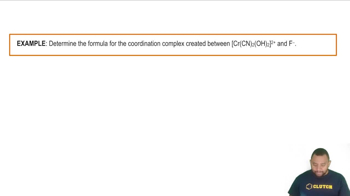
Coordination complexes consist of a central metal atom or ion bonded to surrounding molecules or ions called ligands. In this case, ethylenediamine serves as a bidentate ligand, meaning it can attach to the metal at two donor atoms, specifically the nitrogen atoms in its structure, forming a stable complex with Ni2+.
Video consigliato:
Percorso guidato
00:43
Coordination Complexes Example

Coordination Number and Geometry

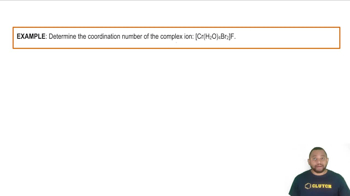
The coordination number refers to the number of ligand donor atoms that are bonded to the central metal ion. For the complex [Ni(en)3]2+, the coordination number is 6, as there are three bidentate ethylenediamine ligands. This arrangement typically results in an octahedral geometry around the nickel ion.
Video consigliato:
Percorso guidato
00:51
Coordination Numbers and Geometry Example