Ch.21 - Transition Elements and Coordination Chemistry
McMurry - Chemistry 8th Edition
McMurry8th EditionChemistryISBN: 9781292336145Non è quello che usi tu?Cambia libro di testo
Capitolo 21, Problema 21.116

Although Cl- is a weak-field ligand and CN- is a strong field ligand, [CrCl6]3- and [Cr(CN)6]3- exhibit approximately the same amount of paramagnetism. Explain.

Guida verificata passo dopo passo
1
Identify the oxidation state of chromium in both complexes. Chromium is in the +3 oxidation state in both [CrCl_6]^{3-} and [Cr(CN)_6]^{3-}.
Determine the electron configuration of the Cr^{3+} ion. Chromium has an atomic number of 24, so its electron configuration is [Ar] 3d^5 4s^1. For Cr^{3+}, remove three electrons, resulting in [Ar] 3d^3.
Consider the effect of ligand field strength on the d-orbitals. Cl^- is a weak-field ligand, leading to a high-spin complex, while CN^- is a strong-field ligand, typically leading to a low-spin complex.
Analyze the number of unpaired electrons. In both complexes, the Cr^{3+} ion has three unpaired electrons in the 3d orbitals, resulting in similar paramagnetic properties.
Conclude that despite the difference in ligand field strength, the number of unpaired electrons remains the same in both complexes, explaining the similar paramagnetism.

Risposta video verificata per un problema simile:

Questa soluzione video è stata consigliata dai nostri tutor come utile per risolvere questo problema.

Concetti chiave

Ecco i concetti essenziali che devi comprendere per rispondere correttamente alla domanda.

Ligand Field Theory

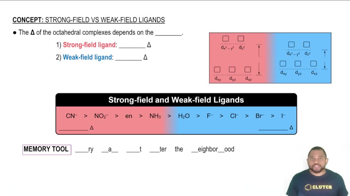
Ligand Field Theory explains how the presence of ligands around a central metal ion affects its electronic structure and the energy levels of its d-orbitals. Strong-field ligands, like CN<sup>-</sup>, cause a larger splitting of d-orbitals compared to weak-field ligands, like Cl<sup>-</sup>. This theory helps in understanding the magnetic properties of coordination complexes based on the arrangement and strength of the ligands.
Video consigliato:
Percorso guidato
02:40
Strong-Field Ligands result in a large Δ and Weak-Field Ligands result in a small Δ.

Paramagnetism

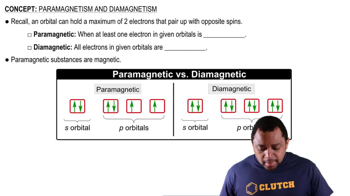
Paramagnetism is a form of magnetism that occurs in materials with unpaired electrons. In coordination complexes, the number of unpaired electrons determines the degree of paramagnetism. Both [CrCl<sub>6</sub>]<sup>3-</sup> and [Cr(CN)<sub>6</sub>]<sup>3-</sup> can exhibit similar levels of paramagnetism if they have the same number of unpaired electrons, despite the differences in ligand strength.
Video consigliato:
Percorso guidato
01:33
Paramagnetism and Diamagnetism

Crystal Field Splitting

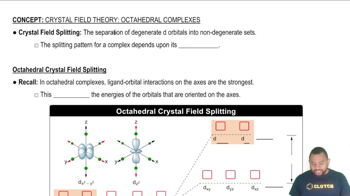
Crystal Field Splitting refers to the energy difference between the split d-orbitals in a transition metal complex due to the presence of ligands. In octahedral complexes, the d-orbitals split into two sets: t<sub>2g</sub> and e<sub>g</sub>. The extent of this splitting influences the electron configuration and, consequently, the magnetic properties of the complex, which can lead to similar paramagnetic behavior in complexes with different ligands.
Video consigliato:
Percorso guidato
03:04
The crystal field splitting pattern for octahedral complexes has the d orbitals on or along the axes as having the higher energy.