Ch.21 - Transition Elements and Coordination Chemistry

McMurry8th EditionChemistryISBN: 9781292336145
Non è quello che usi tu?Cambia libro di testoScegli un libro di testo diverso
TOC.tableOfContents
- Ch.1 - Chemical Tools: Experimentation & Measurement170
- Ch.2 - Atoms, Molecules & Ions160
- Ch.3 - Mass Relationships in Chemical Reactions169
- Ch.4 - Reactions in Aqueous Solution199
- Ch.5 - Periodicity & Electronic Structure of Atoms102
- Ch.6 - Ionic Compounds: Periodic Trends and Bonding Theory92
- Ch.7 - Covalent Bonding and Electron-Dot Structures61
- Ch.8 - Covalent Compounds: Bonding Theories and Molecular Structure59
- Ch.9 - Thermochemistry: Chemical Energy122
- Ch.10 - Gases: Their Properties & Behavior155
- Ch.11 - Liquids & Phase Changes54
- Ch.12 - Solids and Solid-State Materials73
- Ch.13 - Solutions & Their Properties120
- Ch.14 - Chemical Kinetics98
- Ch.15 - Chemical Equilibrium125
- Ch.16 - Aqueous Equilibria: Acids & Bases110
- Ch.17 - Applications of Aqueous Equilibria147
- Ch.18 - Thermodynamics: Entropy, Free Energy & Equilibrium86
- Ch.19 - Electrochemistry154
- Ch.20 - Nuclear Chemistry96
- Ch.21 - Transition Elements and Coordination Chemistry156
- Ch.22 - The Main Group Elements187
- Ch.23 - Organic and Biological Chemistry51
Tutti i libri di testo McMurry 8th EditionCh.21 - Transition Elements and Coordination ChemistryProblema 142
McMurry 8th EditionCh.21 - Transition Elements and Coordination ChemistryProblema 142Capitolo 21, Problema 142
An alternative to cyanide leaching of gold ores is leaching with thiocyanate ion, which forms a square planar gold(III) complex, Au(SCN)4^3-. (a) If the formation constant for Au(SCN)4^3- is Kf = 10^37, what is the equilibrium concentration of Au^3+ in a 0.050 M solution of Au(SCN)4^3-?
 Guida verificata passo dopo passo
1
Identify the chemical equilibrium involved: Au^3+ + 4 SCN^- ⇌ Au(SCN)_4^3-. The formation constant (K_f) for this reaction is given as 10^37.
Write the expression for the formation constant (K_f) in terms of the concentrations: K_f = [Au(SCN)_4^3-] / ([Au^3+][SCN^-]^4).
Assume that the initial concentration of Au(SCN)_4^3- is 0.050 M and that it dissociates slightly to form Au^3+ and SCN^-. Let the change in concentration of Au^3+ be x, so [Au^3+] = x and [SCN^-] = 4x.
Substitute the equilibrium concentrations into the K_f expression: 10^37 = (0.050) / (x * (4x)^4).
Solve the equation for x, which represents the equilibrium concentration of Au^3+. This involves algebraic manipulation and solving a polynomial equation.
Concetti chiave
Ecco i concetti essenziali che devi comprendere per rispondere correttamente alla domanda.
Formation Constant (Kf)
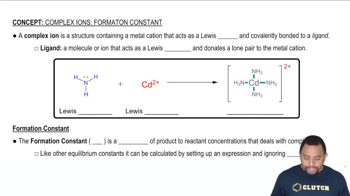
The formation constant, Kf, is a measure of the stability of a complex ion in solution. It quantifies the extent to which reactants form a complex at equilibrium. A higher Kf value indicates a more stable complex, meaning that the equilibrium will favor the formation of the complex over the dissociation into its constituent ions.
Video consigliato:
Percorso guidato
 02:20
02:20
Complex Ions and Formation Constant
Equilibrium Concentration
Equilibrium concentration refers to the concentrations of reactants and products in a chemical reaction at equilibrium. In this context, it is essential to determine the concentration of Au^3+ ions when Au(SCN)4^3- is present in solution. The relationship between the concentrations of the complex and the free ions can be described using the equilibrium expression derived from the formation constant.
Video consigliato:
Percorso guidato
 02:35
02:35Thermal Equilibrium
Square Planar Geometry
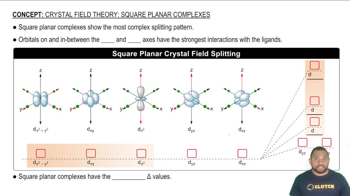
Square planar geometry is a molecular shape where four ligands are arranged around a central metal ion in a square plane. This geometry is common for d8 metal ions like Au(III). Understanding the geometry helps in predicting the behavior of the complex in solution, including its stability and reactivity, which are crucial for calculating equilibrium concentrations.
Video consigliato:
Percorso guidato
 02:07
02:07Square planar complexes show the most complex splitting pattern.
Pratica correlata