
Ch.21 - Transition Elements and Coordination Chemistry
McMurry - Chemistry 8th Edition
McMurry8th EditionChemistryISBN: 9781292336145Non è quello che usi tu?Cambia libro di testo
Capitolo 21, Problema 21.134d

Spinach contains a lot of iron but is not a good source of dietary iron because nearly all the iron is tied up in the oxalate complex [Fe(C2O4)3]3-.
(d) Draw the structure of [Fe(C2O4)3]3-. Is the complex chiral or achiral?

Guida verificata passo dopo passo
1
Identify the components of the complex ion: the central metal ion is Fe (iron) and the ligands are oxalate ions (C_2O_4^2-).
Understand the coordination geometry: Iron in this complex is typically in an octahedral geometry, coordinated by three bidentate oxalate ligands.
Draw the structure: Arrange the three oxalate ligands around the central iron atom in an octahedral fashion, ensuring each oxalate forms two bonds with the iron.
Consider chirality: A complex is chiral if it cannot be superimposed on its mirror image. In an octahedral complex with three bidentate ligands, check for symmetry elements like a plane of symmetry or a center of inversion.
Determine chirality: If the complex lacks symmetry elements that would make it superimposable on its mirror image, it is chiral; otherwise, it is achiral.

Risposta video verificata per un problema simile:

Questa soluzione video è stata consigliata dai nostri tutor come utile per risolvere questo problema.

Concetti chiave

Ecco i concetti essenziali che devi comprendere per rispondere correttamente alla domanda.

Coordination Complexes

Coordination complexes consist of a central metal atom bonded to surrounding molecules or ions, known as ligands. In this case, iron (Fe) is the central atom, and oxalate (C2O4) acts as a bidentate ligand, forming a stable complex. Understanding the structure and bonding in coordination complexes is essential for analyzing their properties and behavior.
Video consigliato:
Percorso guidato
00:43
Coordination Complexes Example

Chirality

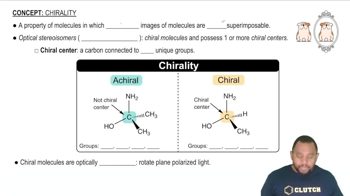
Chirality refers to the geometric property of a molecule that makes it non-superimposable on its mirror image, much like left and right hands. A chiral molecule typically has no plane of symmetry, while an achiral molecule does. Determining whether a complex is chiral or achiral involves analyzing its symmetry elements and spatial arrangement of ligands around the central metal atom.
Video consigliato:

Oxalate Ligand

Oxalate (C2O4) is a bidentate ligand, meaning it can form two bonds with a metal center. This ligand can significantly influence the stability and geometry of the resulting coordination complex. In the case of [Fe(C2O4)3]3-, the oxalate ligands create a specific arrangement around the iron atom, which is crucial for determining the complex's chirality.
Video consigliato:
Percorso guidato
01:12
Ligands Example
Pratica correlata
Domanda del libro di testo

Cobalt(III) trifluoroacetylacetonate, Co1tfac23, is a sixcoordinate, octahedral metal chelate in which three planar, bidentate tfac ligands are attached to a central Co atom:

(d) Draw a crystal field energy-level diagram for Co1tfac23, and predict its magnetic properties. (In this complex, tfac is a strong-field ligand.)

111
views
Domanda del libro di testo

The percent iron in iron ore can be determined by dissolving the ore in acid, then reducing the iron to Fe2+, and finally titrating the Fe2+ with aqueous KMnO4. The reaction products are Fe2+ and Mn2+.

(c) Draw a crystal field energy-level diagram for the reactants and products, MnO4-, 3Fe1H2O2642+, 3Fe1H2O2643+, and 3Mn1H2O2642+, and predict the number of unpaired electrons for each.

101
views
Domanda del libro di testo

For each of the following complexes, draw a crystal field energy-level diagram, assign the electrons to orbitals, and predict the number of unpaired electrons.

(c) [Co(NCS)4]2- (tetrahedral)

112
views
Domanda del libro di testo

In acidic aqueous solution, the complex trans-[Co(en)2Cl1]2+(aq) undergoes the following substitution reaction:

trans-[Co(en)1Cl2]+(aq) + H2O(l) → trans-[Co(en)2(H2O)Cl]2+(aq) + Cl–(aq)

The reaction is first order in trans-[Co(en)2Cl2]+(aq), and the rate constant at 25°C is 3.2×10⁻⁵ s–1.

(d) Is the reaction product chiral or achiral? Explain.

77
views
Domanda del libro di testo

Nickel(II) complexes with the formula NiX2L2, where X is Cl- or N-bonded NCS- and L is the monodentate triphenylphosphine ligand P(C6H5)3, can be square planar or tetrahedral.

(c) Draw possible structures for each of the NiX2L2 complexes, and tell which ones have a dipole moment.

96
views
Domanda del libro di testo

In acidic aqueous solution, the complex trans-[Co(en)2Cl1]2+(aq) undergoes the following substitution reaction:

trans-[Co(en)2Cl1]+(aq) + H2O(l) → trans-[Co(en)2(H2O)Cl]2+(aq) + Cl–(aq)

The reaction is first order in trans-[Co(en)2Cl2]+(aq), and the rate constant at 25°C is 3.2×10⁻⁵ s–1.

e. Draw a crystal field energy-level diagram for trans-[Co(en)2Cl2]+ that takes account of the fact that Cl– is a weaker-field ligand than ethylenediamine.

82
views