Domanda del libro di testo
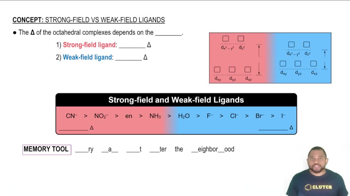
In octahedral complexes, the choice between high-spin and low-spin electron configurations arises only for d4 - d7 complexes. Explain.
112
views

 McMurry 8th EditionCh.21 - Transition Elements and Coordination ChemistryProblema 118
 Guida verificata passo dopo passo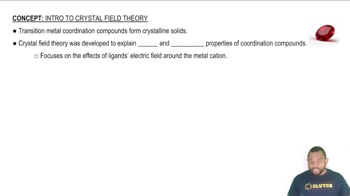
 01:18
01:18
 02:40
02:40 01:32
01:32In octahedral complexes, the choice between high-spin and low-spin electron configurations arises only for d4 - d7 complexes. Explain.
For each of the following, (i) give the systematic name of the compound and specify the oxidation state of the transition metal, (ii) draw a crystal field energy-level diagram and assign the d electrons to orbitals, (iii) indicate whether the complex is high-spin or low-spin (for d4 - d7 complexes), and (iv) specify the number of unpaired electrons.
(c) [Ni(NH3)4(H2O)2](NO3)2
For each of the following, (i) give the systematic name of the compound and specify the oxidation state of the transition metal, (ii) draw a crystal field energy-level diagram and assign the d electrons to orbitals, (iii) indicate whether the complex is high-spin or low-spin (for d4 - d7 complexes), and (iv) specify the number of unpaired electrons. (d) K4[Os(CN)6]
For each of the following, (i) give the systematic name of the compound and specify the oxidation state of the transition metal, (ii) draw a crystal field energy-level diagram and assign the d electrons to orbitals, (iii) indicate whether the complex is high-spin or low-spin (for d4 - d7 complexes), and (iv) specify the number of unpaired electrons.
(a) (NH4)[Cr(H2O)6](SO4)2