The glycinate anion, gly-= NH2CH2CO2 -, bonds to metal ions through the N atom and one of the O atoms. Using to represent gly-, sketch the structures of the four stereoisomers of Co(gly)3.
Ch.21 - Transition Elements and Coordination Chemistry
Tutti i libri di testo
McMurry 8th Edition
Ch.21 - Transition Elements and Coordination Chemistry
Problema 21.112
McMurry 8th Edition
Ch.21 - Transition Elements and Coordination Chemistry
Problema 21.112Capitolo 21, Problema 21.112
Draw a crystal field energy-level diagram for a square planar complex, and explain why square planar geometry is especially common for d8 complexes.
Guida verificata passo dopo passo1
Identify the metal ion and its oxidation state in the square planar complex. This will help determine the electron configuration and the number of d electrons present.
Understand that in a square planar complex, the ligands are positioned at the corners of a square in the xy-plane, leading to a specific splitting pattern of the d orbitals.
Recognize that the d orbitals split into different energy levels due to the ligand field. For a square planar complex, the order of increasing energy is typically: dz2, dxy, dyz = dxz, and dx2-y2.
Place the d electrons into the energy levels according to Hund's rule and the Pauli exclusion principle, starting from the lowest energy level. For a d8 complex, fill the lower energy orbitals first.
Explain that square planar geometry is common for d8 complexes because it allows for a stable electron configuration with lower energy, minimizing electron repulsion and maximizing ligand field stabilization energy.

Risposta video verificata per un problema simile:
Questa soluzione video è stata consigliata dai nostri tutor come utile per risolvere questo problema.
Concetti chiave
Ecco i concetti essenziali che devi comprendere per rispondere correttamente alla domanda.
Crystal Field Theory
Crystal Field Theory (CFT) explains how the arrangement of ligands around a central metal ion affects the energy levels of the d-orbitals. In a square planar geometry, the ligands are positioned in a way that causes specific splitting of the d-orbitals, leading to distinct energy levels. This theory helps predict the electronic structure and color of coordination complexes.
Video consigliato:
Percorso guidato
The study of ligand-metal interactions helped to form Ligand Field Theory which combines CFT with MO Theory.
d<sup>8</sup> Electron Configuration
The d<sup>8</sup> electron configuration refers to transition metal complexes that have eight electrons in their d-orbitals. This configuration is particularly stable in square planar complexes, as it allows for optimal pairing of electrons and minimizes electron-electron repulsion. Common examples include complexes of metals like nickel(II) and platinum(II).
Video consigliato:
Percorso guidato
Electron Configuration Example
Ligand Field Stabilization Energy (LFSE)
Ligand Field Stabilization Energy (LFSE) is the energy difference between the actual electronic configuration of a complex and the hypothetical configuration where all d-electrons are in the highest energy level. In square planar complexes, d<sup>8</sup> configurations can achieve a high LFSE due to effective pairing and lower energy arrangements, making this geometry energetically favorable.
Video consigliato:
Percorso guidato
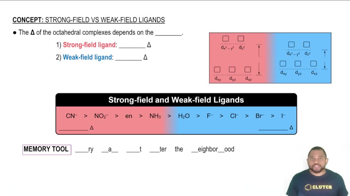
Strong-Field Ligands result in a large Δ and Weak-Field Ligands result in a small Δ.
Pratica correlata
Domanda del libro di testo
134
views
Domanda del libro di testo
What is the oxidation state of the metal in each of the complexes?
a. [Ni(CN)5]3–
b. Ni(CO)4
c. [Co(en)2(H2O)Br]2+
d. [Cu(H2O)2(C2O4)2]2–
e. Co(NH3)3(NO2)3
72
views
Domanda del libro di testo
Draw all possible diastereoisomers of [Cr(C2O4)2(H2O)2]-. Which can exist as a pair of enantiomers?
120
views
Domanda del libro di testo
Which of the following complexes can exist as diastereoisomers?
(a) [Cr(NH3)2Cl4]-
(b) [Co(NH3)5Br]2+
(c) [MnCl2Br2]2- (tetrahedral)
(d) [Pt(NH3)2Br2]2-
89
views
Domanda del libro di testo
Predict the number of unpaired electrons for each of the following.
(c) Zn2+
(d) Cr3+
86
views
Domanda del libro di testo
Explain why [CoCl4]2- (blue) and [Co(H2O)6]2+ (pink) have different colors. Which complex has its absorption bands at longer wavelengths?
117
views
1
rank