Ch.21 - Transition Elements and Coordination Chemistry

McMurry8th EditionChemistryISBN: 9781292336145
Non è quello che usi tu?Cambia libro di testoScegli un libro di testo diverso
TOC.tableOfContents
- Ch.1 - Chemical Tools: Experimentation & Measurement170
- Ch.2 - Atoms, Molecules & Ions160
- Ch.3 - Mass Relationships in Chemical Reactions169
- Ch.4 - Reactions in Aqueous Solution199
- Ch.5 - Periodicity & Electronic Structure of Atoms102
- Ch.6 - Ionic Compounds: Periodic Trends and Bonding Theory92
- Ch.7 - Covalent Bonding and Electron-Dot Structures61
- Ch.8 - Covalent Compounds: Bonding Theories and Molecular Structure59
- Ch.9 - Thermochemistry: Chemical Energy122
- Ch.10 - Gases: Their Properties & Behavior155
- Ch.11 - Liquids & Phase Changes54
- Ch.12 - Solids and Solid-State Materials73
- Ch.13 - Solutions & Their Properties120
- Ch.14 - Chemical Kinetics98
- Ch.15 - Chemical Equilibrium125
- Ch.16 - Aqueous Equilibria: Acids & Bases110
- Ch.17 - Applications of Aqueous Equilibria147
- Ch.18 - Thermodynamics: Entropy, Free Energy & Equilibrium86
- Ch.19 - Electrochemistry154
- Ch.20 - Nuclear Chemistry96
- Ch.21 - Transition Elements and Coordination Chemistry156
- Ch.22 - The Main Group Elements187
- Ch.23 - Organic and Biological Chemistry51
Tutti i libri di testo McMurry 8th EditionCh.21 - Transition Elements and Coordination ChemistryProblema 138
McMurry 8th EditionCh.21 - Transition Elements and Coordination ChemistryProblema 138Capitolo 21, Problema 138
In acidic aqueous solution, the complex trans-[Co(en)2Cl2]+ undergoes the following substitution reaction: The reaction is first order in trans-[Co(en)2Cl2]+, and the rate constant at 25 °C is 3.2 × 10⁻⁵ s⁻¹. (a) What is the half-life of the reaction in hours? (b) If the initial concentration of trans-[Co(en)2Cl2]+ is 0.138 M, what is its molarity after a reaction time of 16.5 h? (c) Devise a possible reaction mechanism with a unimolecular rate-determining step.
 Guida verificata passo dopo passo
1
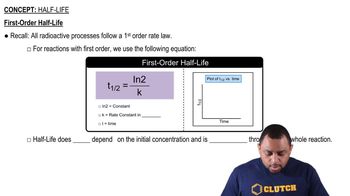
Step 1: To find the half-life of a first-order reaction, use the formula: \(t_{1/2} = \frac{0.693}{k}\), where \(k\) is the rate constant.
Step 2: Convert the rate constant from seconds to hours by multiplying by the number of seconds in an hour (3600 s/h).
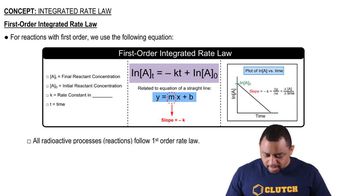
Step 3: For part (b), use the first-order integrated rate law: \([A] = [A]_0 e^{-kt}\), where \([A]_0\) is the initial concentration, \(k\) is the rate constant, and \(t\) is the time in hours.
Step 4: Substitute the given values into the integrated rate law to find the concentration after 16.5 hours.
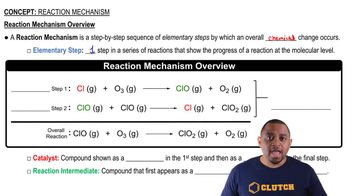
Step 5: For part (c), propose a reaction mechanism. A possible mechanism could involve the dissociation of one ligand from the complex to form an intermediate, followed by the substitution of another ligand. The rate-determining step would be the slowest step, likely the initial dissociation.
Concetti chiave
Ecco i concetti essenziali che devi comprendere per rispondere correttamente alla domanda.
First-Order Reactions
First-order reactions are characterized by a rate that is directly proportional to the concentration of one reactant. In this case, the rate of the reaction involving trans-[Co(en)2Cl2]+ depends solely on its concentration. The half-life of a first-order reaction is constant and can be calculated using the formula t½ = 0.693/k, where k is the rate constant.
Video consigliato:
Percorso guidato
 02:29
02:29
First-Order Reactions
Half-Life Calculation
The half-life of a reaction is the time required for the concentration of a reactant to decrease to half of its initial value. For first-order reactions, this value is independent of the initial concentration and can be calculated using the rate constant. Understanding how to calculate half-life is essential for determining how long it takes for a reactant to diminish over time.
Video consigliato:
Percorso guidato
 01:49
01:49First-Order Half-Life
Reaction Mechanism
A reaction mechanism describes the step-by-step sequence of elementary reactions by which overall chemical change occurs. In this context, a unimolecular rate-determining step implies that the rate of the reaction is governed by the transformation of a single reactant species. Proposing a mechanism involves identifying intermediates and the sequence of events leading to product formation, which is crucial for understanding the kinetics of the reaction.
Video consigliato:
Percorso guidato
 03:06
03:06Reaction Mechanism Overview
Pratica correlata