
Ch.21 - Transition Elements and Coordination Chemistry
McMurry - Chemistry 8th Edition
McMurry8th EditionChemistryISBN: 9781292336145Non è quello che usi tu?Cambia libro di testo
Capitolo 21, Problema 130

There are three coordination compounds with the empirical
formula Co1NH3231NO223 in which all the nitrite ions
are bonded through the N atom. Two isomers have the
same molar mass but different nonzero dipole moments.
The third compound is a salt with singly charged ions and a molar mass twice that of the other compounds.
(a) Draw the structures of the isomeric compounds.

Guida verificata passo dopo passo
1
Identify the coordination number and geometry of the cobalt complex. Cobalt typically forms octahedral complexes with a coordination number of 6.
Determine the possible isomers. Since the nitrite ions are bonded through the nitrogen atom, consider linkage isomerism and geometric isomerism.
For the two isomers with nonzero dipole moments, consider cis and trans arrangements of the ligands around the cobalt center. In a cis isomer, similar ligands are adjacent, while in a trans isomer, they are opposite.
Draw the structures of the cis and trans isomers. In the cis isomer, place two nitrite ions adjacent to each other, and in the trans isomer, place them opposite each other.
For the third compound, which is a salt, consider that it has a molar mass twice that of the other compounds. This suggests it is a dimer or contains additional ions. Draw a structure that reflects this, possibly with two cobalt centers or additional counterions.

Risposta video verificata per un problema simile:

Questa soluzione video è stata consigliata dai nostri tutor come utile per risolvere questo problema.

Concetti chiave

Ecco i concetti essenziali che devi comprendere per rispondere correttamente alla domanda.

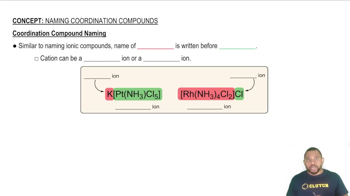
Coordination Compounds

Coordination compounds consist of a central metal atom or ion bonded to surrounding molecules or ions, known as ligands. The nature of these bonds can significantly influence the properties of the compound, including its geometry and reactivity. Understanding the coordination number and the types of ligands involved is essential for predicting the structure and behavior of these compounds.
Video consigliato:
Percorso guidato
01:32
Coordination Compound Naming

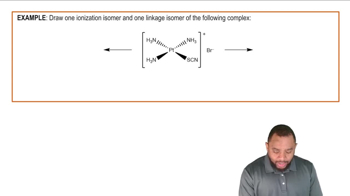
Isomerism in Coordination Compounds

Isomerism in coordination compounds occurs when two or more compounds have the same molecular formula but different arrangements of atoms. This can include structural isomers, where the connectivity of atoms differs, and stereoisomers, where the spatial arrangement of atoms varies. The presence of different isomers can lead to variations in physical properties, such as dipole moments, which are crucial for understanding the behavior of these compounds.
Video consigliato:
Percorso guidato
2:14
Isomerism in Coordination Complexes Example

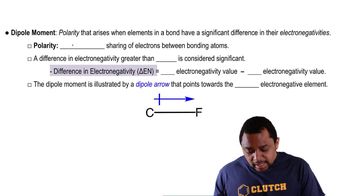
Dipole Moment

The dipole moment is a measure of the separation of positive and negative charges in a molecule, indicating its polarity. It is influenced by the molecular geometry and the electronegativity of the atoms involved. In coordination compounds, differences in dipole moments between isomers can arise from variations in ligand arrangement, affecting their interactions with electric fields and solvents, which is important for predicting their chemical behavior.
Video consigliato: