
Ch.21 - Transition Elements and Coordination Chemistry
McMurry - Chemistry 8th Edition
McMurry8th EditionChemistryISBN: 9781292336145Non è quello che usi tu?Cambia libro di testo
Capitolo 21, Problema 3

What is the Lewis base in the reaction of oxalate with the mangenese ion to form [Mn(C2O4)3]2-? What is the oxidation state of Mn and the coordination number of the complex?  
(a) Lewis base is C2O42-; Mn oxidation number is +3; coordination number is 3.
(b) Lewis base is C2O42-; Mn oxidination number is +2; coordination number is 6.
(c) Lewis base is Mn2+; Mn oxidation number is +2; coordination number is 3.
(d) Lewis base is Mn4+; Mn oxidation number is +4; coordination number is 6.

Guida verificata passo dopo passo
1
Identify the Lewis base in the reaction. A Lewis base is a species that donates an electron pair. In the reaction forming [Mn(C2O4)3]2-, oxalate (C2O4^2-) donates electron pairs to form bonds with the manganese ion.
Determine the oxidation state of manganese (Mn) in the complex [Mn(C2O4)3]2-. Since the complex has an overall charge of -2 and each oxalate ion (C2O4^2-) has a charge of -2, calculate the total charge contributed by the oxalate ions and use it to find the oxidation state of Mn.
Calculate the coordination number of the complex. The coordination number is the number of ligand atoms that are directly bonded to the central metal ion. Count the number of oxalate ions coordinating with Mn and consider the bidentate nature of oxalate (each oxalate coordinates through two oxygen atoms).
Match the calculated values of the oxidation state and coordination number with the given options to find the correct answer.
Confirm that the Lewis base, oxidation state, and coordination number align with the properties and definitions in coordination chemistry.

Risposta video verificata per un problema simile:

Questa soluzione video è stata consigliata dai nostri tutor come utile per risolvere questo problema.

Concetti chiave

Ecco i concetti essenziali che devi comprendere per rispondere correttamente alla domanda.

Lewis Acids and Bases

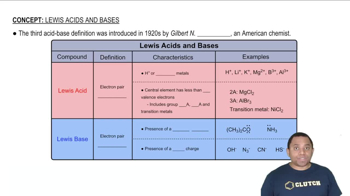
In Lewis theory, a Lewis base is defined as a species that donates an electron pair to form a covalent bond, while a Lewis acid accepts an electron pair. In the reaction involving oxalate and the manganese ion, the oxalate ion (C2O4^2-) acts as the Lewis base by donating electron pairs to the manganese ion, facilitating the formation of the complex [Mn(C2O4)3]2-.
Video consigliato:
Percorso guidato
05:04
Lewis Acids and Bases

Oxidation State

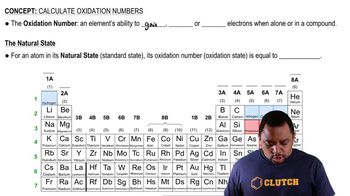
The oxidation state of an element in a compound indicates the degree of oxidation (loss of electrons) of that element. In the case of manganese in the complex [Mn(C2O4)3]2-, determining the oxidation state involves considering the charges of the ligands and the overall charge of the complex. The oxalate ion has a charge of -2, and with three oxalate ions, the total negative charge is -6, leading to an oxidation state of +3 for manganese.
Video consigliato:
Percorso guidato
02:42
Oxidation Numbers

Coordination Number

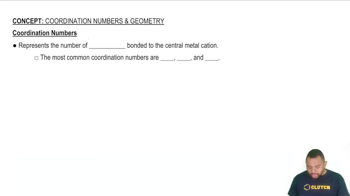
The coordination number of a metal complex refers to the number of ligand atoms that are directly bonded to the central metal ion. In the complex [Mn(C2O4)3]2-, manganese is coordinated to three oxalate ligands, each of which binds through two oxygen atoms, resulting in a coordination number of 6. This reflects the total number of donor atoms surrounding the manganese ion.
Video consigliato:
Percorso guidato
00:27
Coordination Numbers