Domanda del libro di testo
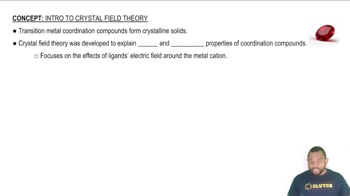
The [Cr(H2O)6]3+ ion is violet, and [Cr(CN)6]3- is yellow. Explain this difference using crystal field theory. Use the colors to order H2O and CN- in the spectrochemical series.
137
views

 McMurry 8th EditionCh.21 - Transition Elements and Coordination ChemistryProblema 21.115
 Guida verificata passo dopo passo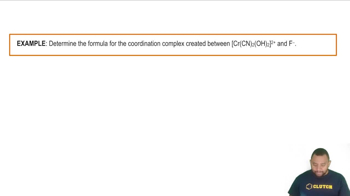
 00:43
00:43
 01:18
01:18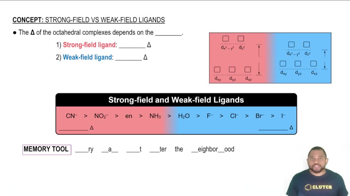 02:40
02:40The [Cr(H2O)6]3+ ion is violet, and [Cr(CN)6]3- is yellow. Explain this difference using crystal field theory. Use the colors to order H2O and CN- in the spectrochemical series.
What is the electron configuration of Co2+ and how many unpaired electrons are in the free transition metal ion?
(a) [Ar]3d54s2; 5 unpaired electrons
(b) [Ar]3d54s2; 1 unpaired electron
(c) [Ar]3d7; 3 unpaired electrons
(d) [Ar]3d7; 1 unpaired electron
What is the oxidation state of the metal in each of the complexes?
a. AgCl2–
b. [Cr(H2O)5Cl]2+
c. [Co(NCS)4]2–
d. [ZrF8]4–
e. [Fe(EDTA)(H2O)]–
What role does EDTA4- play as a trace additive to mayonnaise? Would the glycinate ion (H2NCH2CH2NH2) be an effective substitute for EDTA4-?
Draw the structures of all possible diastereoisomers of an octahedral complex with the formula MA2B2C2. Which of the diastereoisomers, if any, can exist as enantiomers?
For each of the following complexes, draw a crystal field energy-level diagram, assign the electrons to orbitals, and predict the number of unpaired electrons.
(d) [Cu(en)2]2+ (square planar)