Ch.22 - The Main Group Elements
McMurry - Chemistry 8th Edition
McMurry8th EditionChemistryISBN: 9781292336145Non è quello che usi tu?Cambia libro di testo
Capitolo 22, Problema 86a

(a) Describe what is meant by an electron-deficient molecule.

Guida verificata passo dopo passo
1
An electron-deficient molecule is a term used in molecular chemistry to describe a molecule that has fewer than eight electrons around an atom in the molecule. This is in contrast to the 'octet rule' which states that atoms tend to combine in such a way that they each have eight electrons in their valence shells, giving them the same electronic configuration as a noble gas.
The term 'electron-deficient' is often used to describe molecules that cannot form a complete set of bonds using only the electrons from their valence shells. This can occur in molecules with elements from the second period of the periodic table (such as boron, beryllium) which have fewer than four valence electrons.
Electron-deficient molecules are often reactive, as they tend to accept electrons from other atoms or molecules to achieve a stable electron configuration. This makes them good Lewis acids, or electron pair acceptors.
In some cases, electron-deficient molecules can form stable structures by sharing electrons between more than two atoms, resulting in what's known as 'electron-deficient bonding' or '3-center 2-electron bonds'. An example of this is the boron hydrides (boranes).
Understanding the concept of electron-deficient molecules is important in chemistry as it helps predict the reactivity and bonding behavior of molecules.

Risposta video verificata per un problema simile:

Questa soluzione video è stata consigliata dai nostri tutor come utile per risolvere questo problema.

Concetti chiave

Ecco i concetti essenziali che devi comprendere per rispondere correttamente alla domanda.

Electron Deficiency

Electron deficiency refers to a situation where a molecule has fewer electrons than required to achieve a stable electron configuration, typically resembling that of a noble gas. This often occurs in molecules with incomplete octets, leading to a tendency to accept electrons from other species, making them reactive and often acting as Lewis acids.
Video consigliato:
Percorso guidato
04:44
Electron Geometry

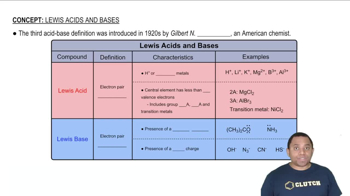
Lewis Acids and Bases

In the Lewis theory, acids are defined as electron pair acceptors, while bases are electron pair donors. Electron-deficient molecules often function as Lewis acids because they can accept electron pairs to complete their octet, facilitating various chemical reactions, including coordination and complex formation.
Video consigliato:
Percorso guidato
05:04
Lewis Acids and Bases

Stability and Reactivity

The stability of a molecule is closely tied to its electron configuration. Electron-deficient molecules are generally less stable and more reactive due to their incomplete valence shells. This reactivity can lead to the formation of new bonds as these molecules seek to achieve a more stable electronic state through interactions with electron-rich species.
Video consigliato:
Percorso guidato
03:13
Intepreting the Band of Stability