
Ch.22 - The Main Group Elements
McMurry - Chemistry 8th Edition
McMurry8th EditionChemistryISBN: 9781292336145Non è quello che usi tu?Cambia libro di testo
Capitolo 22, Problema 1

BF3 reacts with F- to give BF4-, but AlF3 reacts with F- to give AlF63-. Explain.

Guida verificata passo dopo passo
1
and are both Lewis acids, meaning they can accept electron pairs. However, they differ in their ability to expand their coordination number due to the size and electronic configuration of the central atom.
Boron in has an empty p-orbital and can accept one more pair of electrons from , forming . Boron cannot expand its octet beyond four because it lacks d-orbitals.
Aluminum in can expand its coordination number because it has available d-orbitals. This allows it to accept more than one pair of electrons from ions.
When reacts with , it forms . This is possible because aluminum can accommodate six fluorine atoms by utilizing its d-orbitals, forming an octahedral complex.
The difference in behavior between and is due to the ability of aluminum to expand its coordination number by using d-orbitals, while boron cannot do so.

Risposta video verificata per un problema simile:

Questa soluzione video è stata consigliata dai nostri tutor come utile per risolvere questo problema.

Concetti chiave

Ecco i concetti essenziali che devi comprendere per rispondere correttamente alla domanda.

Lewis Acids and Bases

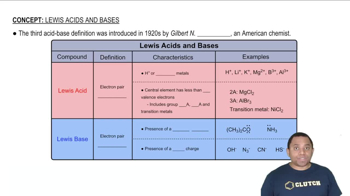
Lewis acids are substances that can accept an electron pair, while Lewis bases are those that can donate an electron pair. In the reaction between BF3 and F-, BF3 acts as a Lewis acid, accepting an electron pair from the fluoride ion to form BF4-. Understanding this concept is crucial for analyzing how different compounds interact based on their electron pair acceptance or donation.
Video consigliato:
Percorso guidato
05:04
Lewis Acids and Bases

Coordination Complexes

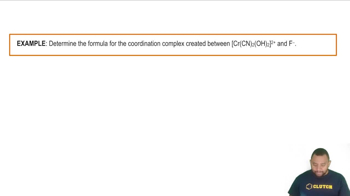
Coordination complexes consist of a central metal atom bonded to surrounding molecules or ions called ligands. In the case of AlF3 reacting with F-, the aluminum ion can coordinate with multiple fluoride ions, leading to the formation of AlF6^3-. This concept is essential for understanding how metal ions can form complex ions with varying numbers of ligands.
Video consigliato:
Percorso guidato
00:43
Coordination Complexes Example

Oxidation States and Coordination Numbers

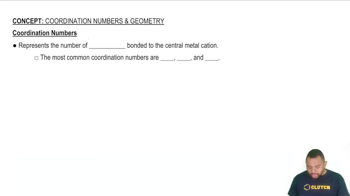
The oxidation state of an element in a compound indicates its degree of oxidation, while the coordination number refers to the number of ligand atoms bonded to the central atom. In AlF3, aluminum has a +3 oxidation state and can accommodate six fluoride ions, resulting in a coordination number of 6 in AlF6^3-. This concept helps explain the different products formed in reactions involving metal halides.
Video consigliato:
Percorso guidato
00:27
Coordination Numbers