Ch.22 - The Main Group Elements

McMurry8th EditionChemistryISBN: 9781292336145
Non è quello che usi tu?Cambia libro di testoScegli un libro di testo diverso
TOC.tableOfContents
- Ch.1 - Chemical Tools: Experimentation & Measurement170
- Ch.2 - Atoms, Molecules & Ions160
- Ch.3 - Mass Relationships in Chemical Reactions169
- Ch.4 - Reactions in Aqueous Solution199
- Ch.5 - Periodicity & Electronic Structure of Atoms102
- Ch.6 - Ionic Compounds: Periodic Trends and Bonding Theory92
- Ch.7 - Covalent Bonding and Electron-Dot Structures61
- Ch.8 - Covalent Compounds: Bonding Theories and Molecular Structure59
- Ch.9 - Thermochemistry: Chemical Energy122
- Ch.10 - Gases: Their Properties & Behavior155
- Ch.11 - Liquids & Phase Changes54
- Ch.12 - Solids and Solid-State Materials73
- Ch.13 - Solutions & Their Properties120
- Ch.14 - Chemical Kinetics98
- Ch.15 - Chemical Equilibrium125
- Ch.16 - Aqueous Equilibria: Acids & Bases110
- Ch.17 - Applications of Aqueous Equilibria147
- Ch.18 - Thermodynamics: Entropy, Free Energy & Equilibrium86
- Ch.19 - Electrochemistry154
- Ch.20 - Nuclear Chemistry96
- Ch.21 - Transition Elements and Coordination Chemistry156
- Ch.22 - The Main Group Elements187
- Ch.23 - Organic and Biological Chemistry51

Capitolo 22, Problema 157
Chlorine reacts with molten sulfur to yield disulfur dichloride, a yellowish-red liquid. Propose a structure for disulfur dichloride.
 Guida verificata passo dopo passo
1
Consider the chemical formula for disulfur dichloride, which is \( \text{S}_2\text{Cl}_2 \). This indicates that the compound contains two sulfur atoms and two chlorine atoms.
Recall that sulfur typically forms two bonds, while chlorine typically forms one bond. This will help in determining how the atoms are connected.
Visualize the structure by starting with the two sulfur atoms. Connect them with a single bond, as sulfur can form a bond with another sulfur atom.
Attach each chlorine atom to one of the sulfur atoms. Since chlorine forms one bond, each chlorine will be singly bonded to a sulfur atom.
Ensure that all atoms satisfy the octet rule, where applicable, and that the structure is consistent with known bonding patterns for sulfur and chlorine.
Risposta video verificata per un problema simile:
Questa soluzione video è stata consigliata dai nostri tutor come utile per risolvere questo problema.
Concetti chiave
Ecco i concetti essenziali che devi comprendere per rispondere correttamente alla domanda.
Molecular Structure
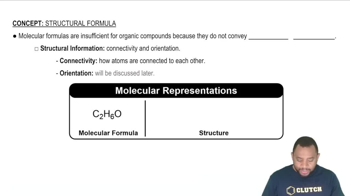
Molecular structure refers to the arrangement of atoms within a molecule, including the types of bonds and the spatial orientation of the atoms. Understanding how atoms bond and the geometry of the resulting molecule is crucial for predicting properties and reactivity. In the case of disulfur dichloride, recognizing the bonding between sulfur and chlorine atoms will help in proposing an accurate structure.
Video consigliato:
Percorso guidato
 02:08
02:08
Molecular Formula
Valence Shell Electron Pair Repulsion (VSEPR) Theory
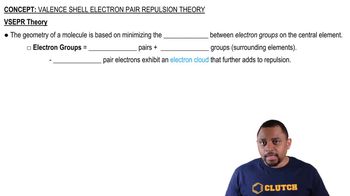
VSEPR theory is a model used to predict the geometry of individual molecules based on the repulsion between electron pairs in the valence shell of the central atom. This theory helps in determining the three-dimensional shape of a molecule, which is essential for understanding its chemical behavior. For disulfur dichloride, applying VSEPR can clarify the arrangement of sulfur and chlorine atoms.
Video consigliato:
Percorso guidato
 00:47
00:47Valence Shell Electron Pair Repulsion Theory
Chemical Bonding
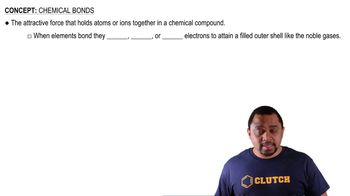
Chemical bonding involves the interactions that hold atoms together in a molecule, primarily through covalent bonds where electrons are shared. In disulfur dichloride, the bonding between sulfur and chlorine is key to its structure and properties. Understanding the nature of these bonds, including bond angles and lengths, is vital for accurately proposing the molecular structure.
Video consigliato:
Percorso guidato
 00:45
00:45Chemical Bonds
Pratica correlata