Identify the group 6A element that best fits each of the following descriptions: (a) Is the most electronegative, (b) Is a semimetal, (c) Is radioactive, (d) Is the most abundant element in the Earth’s crust.
Guida verificata passo dopo passo
1
Step 1: Identify the elements in Group 6A (16) of the periodic table. These elements are oxygen (O), sulfur (S), selenium (Se), tellurium (Te), and polonium (Po).
Step 2: Determine which element is the most electronegative. Electronegativity generally decreases as you move down a group in the periodic table. Oxygen, being at the top of Group 6A, is the most electronegative element in this group.
Step 3: Identify the semimetal (metalloid) in Group 6A. Semimetals have properties intermediate between metals and nonmetals. Tellurium (Te) is the semimetal in Group 6A.
Step 4: Determine which element is radioactive. Polonium (Po) is known for its radioactivity, as it has no stable isotopes.
Step 5: Identify the most abundant element in the Earth's crust from Group 6A. Oxygen is the most abundant element in the Earth's crust, making up a significant portion of it.
Concetti chiave
Ecco i concetti essenziali che devi comprendere per rispondere correttamente alla domanda.
Electronegativity
Electronegativity is a measure of an atom's ability to attract and hold onto electrons in a chemical bond. It is a key factor in determining how atoms interact with each other, influencing bond polarity and the reactivity of elements. In the context of group 6A elements, fluorine is the most electronegative element, which significantly affects its chemical behavior.
Semimetals, or metalloids, possess properties intermediate between metals and nonmetals. They typically have a metallic luster and are good conductors of electricity, but they can also form covalent bonds like nonmetals. In group 6A, tellurium is classified as a semimetal, exhibiting both metallic and nonmetallic characteristics.
Abundance in Earth's Crust
The abundance of elements in the Earth's crust refers to the relative quantities of different elements found in the crustal materials. Oxygen and silicon are the most abundant, but among the group 6A elements, oxygen is the most prevalent. Understanding the distribution of elements helps in various fields, including geology and environmental science.


 Guida verificata passo dopo passo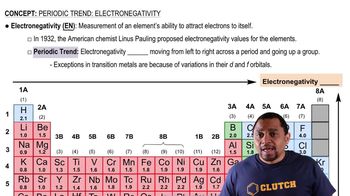
 02:10
02:10