Ch.22 - The Main Group Elements

McMurry8th EditionChemistryISBN: 9781292336145
Non è quello che usi tu?Cambia libro di testoScegli un libro di testo diverso
TOC.tableOfContents
- Ch.1 - Chemical Tools: Experimentation & Measurement170
- Ch.2 - Atoms, Molecules & Ions160
- Ch.3 - Mass Relationships in Chemical Reactions169
- Ch.4 - Reactions in Aqueous Solution199
- Ch.5 - Periodicity & Electronic Structure of Atoms102
- Ch.6 - Ionic Compounds: Periodic Trends and Bonding Theory92
- Ch.7 - Covalent Bonding and Electron-Dot Structures61
- Ch.8 - Covalent Compounds: Bonding Theories and Molecular Structure59
- Ch.9 - Thermochemistry: Chemical Energy122
- Ch.10 - Gases: Their Properties & Behavior155
- Ch.11 - Liquids & Phase Changes54
- Ch.12 - Solids and Solid-State Materials73
- Ch.13 - Solutions & Their Properties120
- Ch.14 - Chemical Kinetics98
- Ch.15 - Chemical Equilibrium125
- Ch.16 - Aqueous Equilibria: Acids & Bases110
- Ch.17 - Applications of Aqueous Equilibria147
- Ch.18 - Thermodynamics: Entropy, Free Energy & Equilibrium86
- Ch.19 - Electrochemistry154
- Ch.20 - Nuclear Chemistry96
- Ch.21 - Transition Elements and Coordination Chemistry156
- Ch.22 - The Main Group Elements187
- Ch.23 - Organic and Biological Chemistry51

Capitolo 22, Problema 144
Little is known about the chemistry of astatine (At) from direct observation, but reasonable predictions can be made.
(a) Is astatine likely to be a gas, a liquid, or a solid?
 Guida verificata passo dopo passo
1
Consider the position of astatine (At) in the periodic table. It is located in Group 17, which is the halogen group.
Recall the states of matter for other halogens at room temperature: fluorine (F) and chlorine (Cl) are gases, bromine (Br) is a liquid, and iodine (I) is a solid.
Understand the trend in the states of matter for halogens as you move down the group: the elements become more solid-like.
Since astatine is below iodine in the periodic table, predict that astatine is likely to be a solid at room temperature.
Conclude that based on periodic trends and the properties of halogens, astatine is most likely a solid.
Risposta video verificata per un problema simile:
Questa soluzione video è stata consigliata dai nostri tutor come utile per risolvere questo problema.
Concetti chiave
Ecco i concetti essenziali che devi comprendere per rispondere correttamente alla domanda.
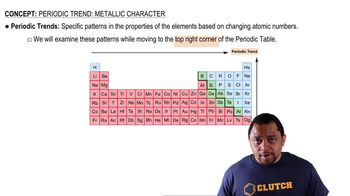
Periodic Trends
Periodic trends refer to the predictable patterns in the properties of elements as you move across or down the periodic table. For instance, elements in the same group often exhibit similar physical and chemical properties. Understanding these trends helps predict the state of an element at room temperature based on its position in the periodic table.
Video consigliato:
Percorso guidato
 00:38
00:38
Periodic Trends
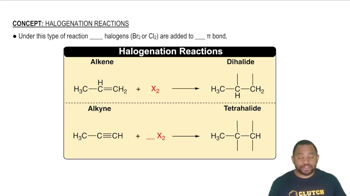
Halogens
Astatine (At) is a member of the halogen group, which includes fluorine, chlorine, bromine, and iodine. Halogens typically have varying states at room temperature, with fluorine and chlorine being gases, bromine a liquid, and iodine a solid. This group’s properties can provide insights into the expected state of astatine, which is likely to be a solid due to its heavier atomic mass.
Video consigliato:
Percorso guidato
 01:11
01:11Halogenation Reactions
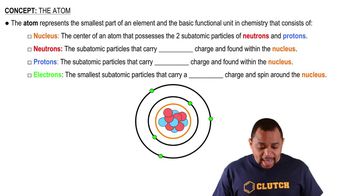
Atomic Structure and Bonding
The atomic structure of an element, including its atomic mass and electron configuration, influences its physical state. Heavier elements tend to have stronger van der Waals forces due to increased electron cloud size, which can lead to solid states at room temperature. Astatine's atomic structure suggests it will exhibit solid characteristics, similar to other heavier halogens.
Video consigliato:
Percorso guidato
 02:10
02:10Atom Structure
Pratica correlata