Ch.22 - The Main Group Elements
McMurry - Chemistry 8th Edition
McMurry8th EditionChemistryISBN: 9781292336145Non è quello che usi tu?Cambia libro di testo
Capitolo 22, Problema 20a

Look at the location of elements A, B, C, and D in the following periodic table:
(a) Write the formula of the simplest binary hydride of each element.

Guida verificata passo dopo passo
1
Identify the group number of each element A, B, C, and D in the periodic table.
Recall that elements in the same group form similar types of binary hydrides with hydrogen.
For each element, determine the typical valency or oxidation state when it forms a hydride.
Write the chemical formula for the binary hydride by combining the element with hydrogen, ensuring the compound is neutral.
Check the periodic trends and common hydride formulas for elements in the same group to verify your answers.

Risposta video verificata per un problema simile:

Questa soluzione video è stata consigliata dai nostri tutor come utile per risolvere questo problema.

Concetti chiave

Ecco i concetti essenziali che devi comprendere per rispondere correttamente alla domanda.

Binary Hydrides

Binary hydrides are compounds formed between hydrogen and another element, typically a nonmetal or a metalloid. The simplest binary hydride is represented by the formula 'EH', where 'E' is the element that combines with hydrogen. The properties and formulas of these hydrides depend on the electronegativity and the group of the element in the periodic table.
Video consigliato:

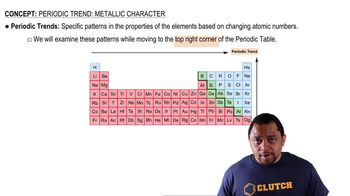
Periodic Table Trends

The periodic table organizes elements based on their atomic number and properties, revealing trends in reactivity, electronegativity, and atomic size. Elements in the same group often exhibit similar chemical behaviors, which can help predict the type of hydride they will form with hydrogen. Understanding these trends is crucial for determining the simplest binary hydrides of elements A, B, C, and D.
Video consigliato:
Percorso guidato
00:38
Periodic Trends

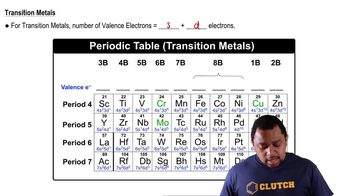
Valence Electrons

Valence electrons are the outermost electrons of an atom and play a key role in chemical bonding. The number of valence electrons determines how an element interacts with hydrogen to form hydrides. For example, elements with one or two valence electrons typically form ionic hydrides, while those with more valence electrons may form covalent hydrides, influencing the formula of the simplest binary hydride.
Video consigliato:
Percorso guidato
02:12
Transition Metals Valence Electrons