Magnesium metal is produced by the electrolysis of molten magnesium chloride using inert electrodes. Predict the anode reaction, cathode reaction, and overall cell reaction.
Guida verificata passo dopo passo
1
Identify the components involved in the electrolysis process: magnesium chloride (MgCl_2) is molten, meaning it is in a liquid state, and the electrodes are inert, meaning they do not participate in the reaction.
Determine the possible reactions at the cathode: In electrolysis, the cathode is where reduction occurs. Magnesium ions (Mg^{2+}) in the molten MgCl_2 will gain electrons to form magnesium metal. The cathode reaction is: \( \text{Mg}^{2+} + 2e^- \rightarrow \text{Mg} \).
Determine the possible reactions at the anode: In electrolysis, the anode is where oxidation occurs. Chloride ions (Cl^-) in the molten MgCl_2 will lose electrons to form chlorine gas. The anode reaction is: \( 2\text{Cl}^- \rightarrow \text{Cl}_2 + 2e^- \).
Combine the half-reactions to write the overall cell reaction: Add the cathode and anode reactions together, ensuring that the electrons cancel out, to find the overall reaction. The overall cell reaction is: \( \text{Mg}^{2+} + 2\text{Cl}^- \rightarrow \text{Mg} + \text{Cl}_2 \).
Verify the charge and mass balance: Ensure that the number of atoms and the charge are balanced on both sides of the overall reaction equation. This confirms the reaction is correctly written.
Concetti chiave
Ecco i concetti essenziali che devi comprendere per rispondere correttamente alla domanda.
Electrolysis
Electrolysis is a chemical process that uses electrical energy to drive a non-spontaneous reaction. In this process, an electric current is passed through an electrolyte, causing the decomposition of the compound. In the case of molten magnesium chloride, electrolysis separates magnesium ions and chloride ions, allowing for the production of magnesium metal at the cathode and chlorine gas at the anode.
In electrolysis, the anode is the electrode where oxidation occurs, while the cathode is where reduction takes place. For molten magnesium chloride, at the anode, chloride ions lose electrons to form chlorine gas, while at the cathode, magnesium ions gain electrons to form magnesium metal. Understanding these half-reactions is crucial for predicting the overall cell reaction.
The overall cell reaction in electrolysis is the sum of the anode and cathode reactions. It represents the complete transformation of reactants into products. For the electrolysis of molten magnesium chloride, the overall reaction combines the formation of magnesium metal and chlorine gas, illustrating the conservation of mass and charge in the process.


 Guida verificata passo dopo passo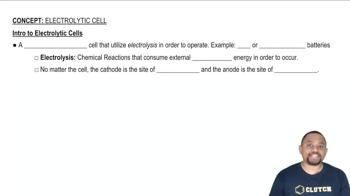
 01:21
01:21