Ch.22 - The Main Group Elements
McMurry - Chemistry 8th Edition
McMurry8th EditionChemistryISBN: 9781292336145Non è quello che usi tu?Cambia libro di testo
Capitolo 22, Problema 91

What is the shape of each of the following molecules or ions, and which hybrid orbitals are used by the central atom? (a) SiO₄⁴⁻ (b) CCl₄ (c) SnCl₂ (d) HCN

Guida verificata passo dopo passo
1
Step 1: For each molecule or ion, determine the central atom and count the total number of valence electrons. Consider any charges on the ion.
Step 2: Use the VSEPR (Valence Shell Electron Pair Repulsion) theory to predict the molecular geometry by considering the number of bonding pairs and lone pairs around the central atom.
Step 3: For each molecule or ion, identify the hybridization of the central atom by considering the number of electron domains (bonding and lone pairs) around it. Use the formula: sp, sp², sp³, etc., where the sum of superscripts equals the number of electron domains.
Step 4: (a) For SiO₄⁴⁻, identify the central atom (Si), count the valence electrons, and predict the shape and hybridization. (b) For CCl₄, identify the central atom (C), count the valence electrons, and predict the shape and hybridization.
Step 5: (c) For SnCl₂, identify the central atom (Sn), count the valence electrons, and predict the shape and hybridization. (d) For HCN, identify the central atom (C), count the valence electrons, and predict the shape and hybridization.

Concetti chiave

Ecco i concetti essenziali che devi comprendere per rispondere correttamente alla domanda.

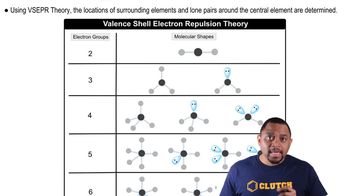
VSEPR Theory

Valence Shell Electron Pair Repulsion (VSEPR) Theory is a model used to predict the geometry of individual molecules based on the repulsion between electron pairs in the valence shell of the central atom. According to this theory, electron pairs will arrange themselves as far apart as possible to minimize repulsion, leading to specific molecular shapes such as tetrahedral, trigonal planar, or linear.
Video consigliato:
Percorso guidato
02:13
Molecular Shapes and VSEPR

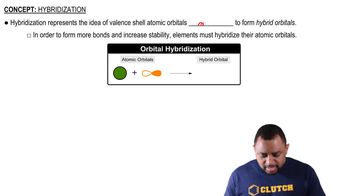
Hybridization

Hybridization is the concept of mixing atomic orbitals to form new hybrid orbitals that can accommodate bonding in molecules. The type of hybridization (e.g., sp, sp², sp³) depends on the number of electron groups around the central atom, influencing both the geometry and bond angles of the molecule. Understanding hybridization is crucial for determining the bonding characteristics of the central atom.
Video consigliato:

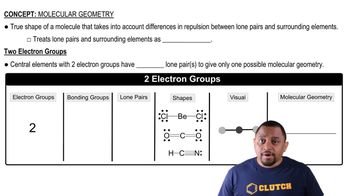
Molecular Geometry

Molecular geometry refers to the three-dimensional arrangement of atoms within a molecule. It is determined by the number of bonding pairs and lone pairs of electrons around the central atom, which affects the overall shape and properties of the molecule. Common geometries include tetrahedral, trigonal bipyramidal, and octahedral, each associated with specific hybridization states.
Video consigliato:
Percorso guidato
01:33
Molecular Geometry with Two Electron Groups