Ch.22 - The Main Group Elements
McMurry - Chemistry 8th Edition
McMurry8th EditionChemistryISBN: 9781292336145Non è quello che usi tu?Cambia libro di testo
Capitolo 22, Problema 22.41a

Which compound in each of the following pairs is more covalent?
(a) PCl3 or AlF3

Guida verificata passo dopo passo
1
Identify the types of bonds present in each compound. PCl₃ and AlF₃ both have polar covalent bonds, but the degree of covalency can differ.
Consider the electronegativity difference between the atoms in each compound. A smaller difference in electronegativity generally indicates a more covalent character.
For PCl₃, compare the electronegativity of phosphorus (P) and chlorine (Cl).
For AlF₃, compare the electronegativity of aluminum (Al) and fluorine (F).
Determine which compound has a smaller electronegativity difference, indicating a more covalent character.

Risposta video verificata per un problema simile:

Questa soluzione video è stata consigliata dai nostri tutor come utile per risolvere questo problema.

Concetti chiave

Ecco i concetti essenziali che devi comprendere per rispondere correttamente alla domanda.

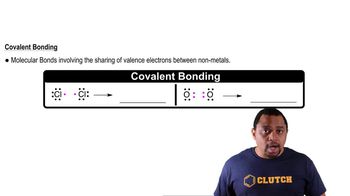
Covalent Bonding

Covalent bonding occurs when two atoms share electrons to achieve a full outer shell, typically between nonmetals. The degree of covalency can vary based on the electronegativity of the atoms involved; the greater the difference in electronegativity, the more ionic the bond becomes. In this context, understanding how covalent bonds form helps in comparing the compounds.
Video consigliato:

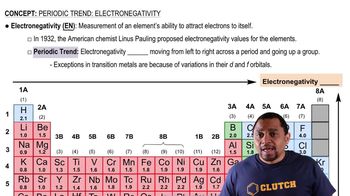
Electronegativity

Electronegativity is a measure of an atom's ability to attract and hold onto electrons in a bond. Elements with similar electronegativities tend to form more covalent bonds, while a large difference indicates a more ionic character. By comparing the electronegativities of phosphorus, chlorine, aluminum, and fluorine, one can determine which compound is more covalent.
Video consigliato:
Percorso guidato
02:10
Electronegativity Trends

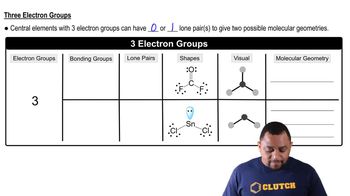
Molecular Structure and Geometry

The molecular structure and geometry of a compound influence its bonding characteristics. For example, PCl3 has a trigonal pyramidal shape, while AlF3 has a more ionic lattice structure. Understanding these geometrical arrangements helps in predicting the nature of the bonds and the overall covalency of the compounds in question.
Video consigliato:
Percorso guidato
01:43
Molecular Geometry with Three Electron Groups