Write a balanced net ionic equation for the reaction of the amphoteric oxide ZnO with aqueous sodium hydroxide. [The product is Zn(OH)4^2-.]
Guida verificata passo dopo passo
1
Identify the reactants and products in the reaction: ZnO (s) and NaOH (aq) react to form Zn(OH)_4^{2-} (aq).
Write the balanced molecular equation for the reaction: ZnO (s) + 2 NaOH (aq) → Na_2Zn(OH)_4 (aq).
Dissociate all strong electrolytes into their ions: NaOH dissociates into Na^+ and OH^-, and Na_2Zn(OH)_4 dissociates into 2 Na^+ and Zn(OH)_4^{2-}.
Write the complete ionic equation by showing all ions separately: ZnO (s) + 2 Na^+ (aq) + 2 OH^- (aq) → 2 Na^+ (aq) + Zn(OH)_4^{2-} (aq).
Cancel out the spectator ions (ions that appear on both sides of the equation) to write the net ionic equation: ZnO (s) + 2 OH^- (aq) → Zn(OH)_4^{2-} (aq).
Concetti chiave
Ecco i concetti essenziali che devi comprendere per rispondere correttamente alla domanda.
Amphoteric Oxides
Amphoteric oxides are compounds that can react with both acids and bases. They exhibit dual behavior, meaning they can either donate protons (acting as acids) or accept protons (acting as bases). Zinc oxide (ZnO) is a classic example, as it can react with strong bases like sodium hydroxide to form complex ions.
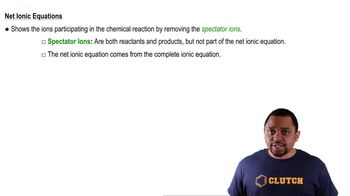
A net ionic equation represents the chemical species that are actually involved in a reaction, omitting the spectator ions that do not participate. To write a net ionic equation, one must first write the balanced molecular equation, then dissociate the soluble strong electrolytes into their ions, and finally eliminate the spectator ions to focus on the core reaction.
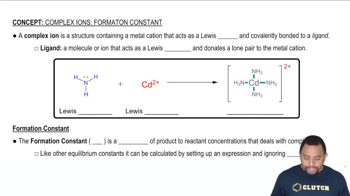
Complex ions are formed when a central metal ion binds with one or more ligands, which are molecules or ions that can donate electron pairs. In this case, the reaction of ZnO with sodium hydroxide leads to the formation of the complex ion Zn(OH)4^2-, where zinc is the central metal ion coordinated by hydroxide ligands, illustrating the interaction between metal oxides and hydroxides.


 Guida verificata passo dopo passo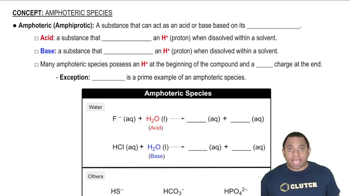
 03:03
03:03