Ch.22 - The Main Group Elements
McMurry - Chemistry 8th Edition
McMurry8th EditionChemistryISBN: 9781292336145Non è quello che usi tu?Cambia libro di testo
Capitolo 22, Problema 70

Write chemical equations for the reaction of potassium with the following substances, making sure that the numbers and kinds of atoms are the same on both sides of the equations. If no reaction occurs, write N.R.
(a) H2O

Guida verificata passo dopo passo
1
Identify the reactants: Potassium (K) and water (H2O).
Recognize that potassium is an alkali metal and reacts with water to form a hydroxide and hydrogen gas.
Write the unbalanced chemical equation: K + H2O -> KOH + H2.
Balance the equation by ensuring the number of each type of atom is the same on both sides.
The balanced equation should reflect the stoichiometry of the reaction, typically involving two potassium atoms reacting with two water molecules.

Risposta video verificata per un problema simile:

Questa soluzione video è stata consigliata dai nostri tutor come utile per risolvere questo problema.

Concetti chiave

Ecco i concetti essenziali che devi comprendere per rispondere correttamente alla domanda.

Chemical Reactions

A chemical reaction involves the transformation of reactants into products, characterized by the breaking and forming of chemical bonds. In a balanced chemical equation, the number of atoms for each element must be the same on both sides, adhering to the law of conservation of mass. Understanding how to represent these reactions is crucial for predicting the outcomes of combining different substances.
Video consigliato:
Percorso guidato
03:31
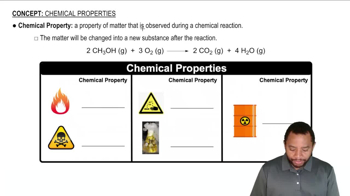
Chemical Properties

Reactivity of Potassium

Potassium is an alkali metal known for its high reactivity, particularly with water. When potassium reacts with water, it typically produces potassium hydroxide and hydrogen gas, often resulting in an exothermic reaction that can be vigorous. Recognizing the reactivity of potassium helps in predicting the products and balancing the chemical equation correctly.
Video consigliato:
Percorso guidato
01:41
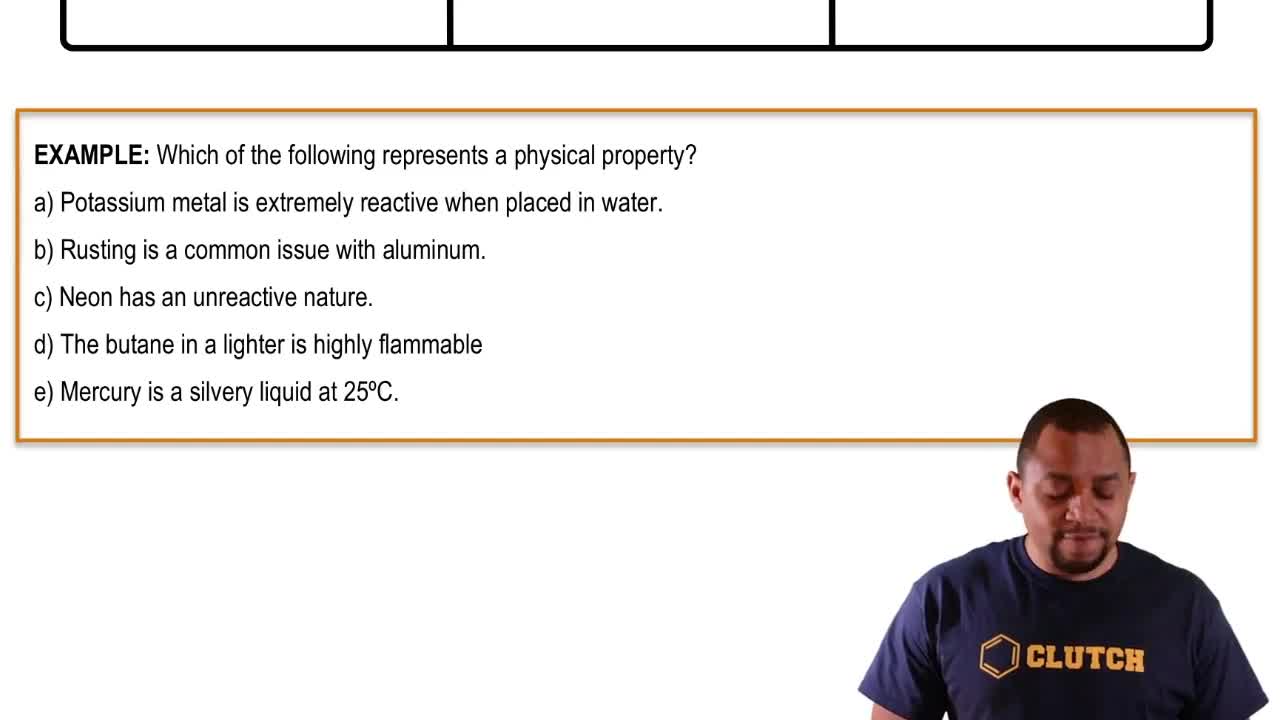
Physical Properties Example

Balancing Chemical Equations

Balancing chemical equations is the process of ensuring that the number of atoms of each element is equal on both sides of the equation. This is achieved by adjusting the coefficients of the reactants and products. Mastery of this concept is essential for accurately representing chemical reactions and understanding stoichiometry, which is vital in predicting the amounts of substances consumed and produced.
Video consigliato:
Percorso guidato
01:32
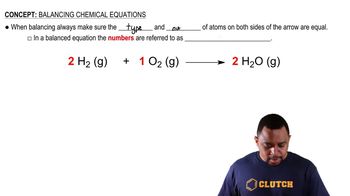
Balancing Chemical Equations