Ch.23 - Organic and Biological Chemistry

McMurry8th EditionChemistryISBN: 9781292336145
Non è quello che usi tu?Cambia libro di testoScegli un libro di testo diverso
TOC.tableOfContents
- Ch.1 - Chemical Tools: Experimentation & Measurement170
- Ch.2 - Atoms, Molecules & Ions160
- Ch.3 - Mass Relationships in Chemical Reactions169
- Ch.4 - Reactions in Aqueous Solution199
- Ch.5 - Periodicity & Electronic Structure of Atoms102
- Ch.6 - Ionic Compounds: Periodic Trends and Bonding Theory92
- Ch.7 - Covalent Bonding and Electron-Dot Structures61
- Ch.8 - Covalent Compounds: Bonding Theories and Molecular Structure59
- Ch.9 - Thermochemistry: Chemical Energy122
- Ch.10 - Gases: Their Properties & Behavior155
- Ch.11 - Liquids & Phase Changes54
- Ch.12 - Solids and Solid-State Materials73
- Ch.13 - Solutions & Their Properties120
- Ch.14 - Chemical Kinetics98
- Ch.15 - Chemical Equilibrium125
- Ch.16 - Aqueous Equilibria: Acids & Bases110
- Ch.17 - Applications of Aqueous Equilibria147
- Ch.18 - Thermodynamics: Entropy, Free Energy & Equilibrium86
- Ch.19 - Electrochemistry154
- Ch.20 - Nuclear Chemistry96
- Ch.21 - Transition Elements and Coordination Chemistry156
- Ch.22 - The Main Group Elements187
- Ch.23 - Organic and Biological Chemistry51

Capitolo 23, Problema 59
Give a line drawing and molecular formula for the following: (a) A linear alkane with four carbon atoms, (b) An alkene with six carbon atoms in a ring and one double bond, (c) A linear alkyne with six carbon atoms and two triple bonds.
 Guida verificata passo dopo passo
1
Identify the structure of a linear alkane with four carbon atoms. Alkanes are saturated hydrocarbons with single bonds only. For four carbon atoms, the structure is a straight chain: C-C-C-C. The molecular formula is C_4H_10.
For an alkene with six carbon atoms in a ring and one double bond, recognize that this is a cycloalkene. A common example is cyclohexene, which has a six-membered carbon ring with one double bond. The molecular formula is C_6H_10.
Consider a linear alkyne with six carbon atoms and two triple bonds. Alkynes are unsaturated hydrocarbons with at least one carbon-carbon triple bond. For two triple bonds, the structure is linear: C≡C-C≡C-C-C. The molecular formula is C_6H_6.
Draw the line structure for each compound. For the alkane, draw a straight line with four vertices representing the carbon atoms. For the cycloalkene, draw a hexagon with one double bond. For the alkyne, draw a straight line with two triple bonds.
Verify the molecular formulas by counting the number of hydrogen atoms needed to satisfy the valency of carbon (four bonds per carbon atom). Ensure the molecular formulas match the structures drawn.
Concetti chiave
Ecco i concetti essenziali che devi comprendere per rispondere correttamente alla domanda.
Alkanes
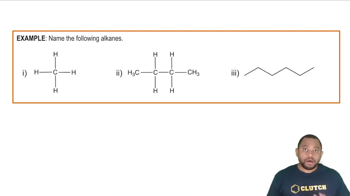
Alkanes are saturated hydrocarbons consisting only of carbon (C) and hydrogen (H) atoms, connected by single bonds. They follow the general formula CnH2n+2, where 'n' is the number of carbon atoms. For example, a linear alkane with four carbon atoms is butane (C4H10), which can be represented in a line drawing showing the carbon backbone with hydrogen atoms attached.
Video consigliato:
Percorso guidato
 01:20
01:20
Naming Alkanes Example
Alkenes
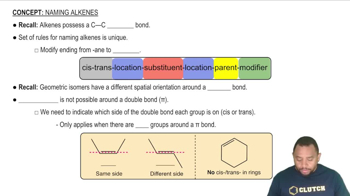
Alkenes are unsaturated hydrocarbons that contain at least one carbon-carbon double bond. They follow the general formula CnH2n, indicating that they have fewer hydrogen atoms than alkanes due to the presence of double bonds. A cyclic alkene with six carbon atoms and one double bond can be represented as cyclohexene (C6H10), where the double bond is depicted in the ring structure.
Video consigliato:
Percorso guidato
 02:47
02:47Rules for Naming Alkenes
Alkynes
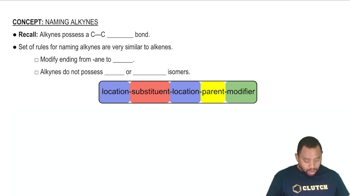
Alkynes are unsaturated hydrocarbons characterized by one or more carbon-carbon triple bonds. They follow the general formula CnH2n-2, which reflects the reduction in hydrogen atoms due to the triple bonds. A linear alkyne with six carbon atoms and two triple bonds can be represented as 1,5-hexadiyne (C6H6), where the structure shows the carbon chain with the appropriate placement of triple bonds.
Video consigliato:
Percorso guidato
 00:53
00:53Rules for Naming Alkynes
Pratica correlata