
Ch.23 - Organic and Biological Chemistry
McMurry - Chemistry 8th Edition
McMurry8th EditionChemistryISBN: 9781292336145Non è quello che usi tu?Cambia libro di testo
Capitolo 23, Problema 144

Isooctane, the substance in gasoline from which the term octane rating derives, has the formula C8H18. Each carbon has four covalent bonds, and the atoms are connected in the sequence shown. Draw the complete structural formula of isooctane.

Guida verificata passo dopo passo
1
Step 1: Understand the molecular formula of isooctane, which is C8H18. This means there are 8 carbon atoms and 18 hydrogen atoms in the molecule.
Step 2: Remember that each carbon atom forms four covalent bonds. This is a fundamental property of carbon due to its four valence electrons.
Step 3: Start drawing the structure by arranging the carbon atoms. Isooctane has a branched structure, with a chain of five carbon atoms and three carbon atoms branching off the second carbon atom in the chain.
Step 4: After arranging the carbon atoms, add the hydrogen atoms. Each carbon atom should be bonded to enough hydrogen atoms such that each carbon atom forms a total of four bonds.
Step 5: Check your structure. Make sure that each carbon atom is forming four bonds (with either carbon or hydrogen), and that you have used all 8 carbon atoms and 18 hydrogen atoms.

Risposta video verificata per un problema simile:

Questa soluzione video è stata consigliata dai nostri tutor come utile per risolvere questo problema.
Durata del video:
1m

Concetti chiave

Ecco i concetti essenziali che devi comprendere per rispondere correttamente alla domanda.

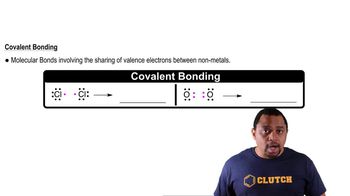
Covalent Bonding

Covalent bonding occurs when two atoms share pairs of electrons, allowing them to achieve a full outer shell and greater stability. In organic compounds like isooctane, carbon atoms typically form four covalent bonds, which can be with other carbon atoms or with hydrogen atoms. This bonding is fundamental to understanding the structure and properties of organic molecules.
Video consigliato:

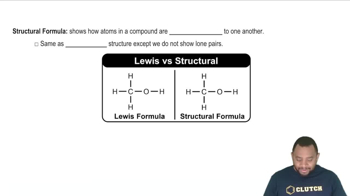
Structural Formula

A structural formula represents the arrangement of atoms within a molecule, showing how atoms are bonded together. It provides more detail than a molecular formula by illustrating the connectivity and spatial orientation of atoms. For isooctane, the structural formula will depict the carbon backbone and the hydrogen atoms attached to each carbon.
Video consigliato:
Percorso guidato
01:00
Structural Formula

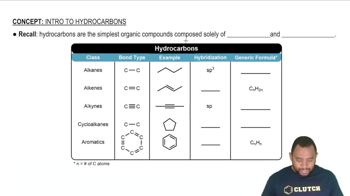
Hydrocarbons

Hydrocarbons are organic compounds composed solely of carbon and hydrogen atoms. They can be classified into aliphatic (straight or branched chains) and aromatic (ring structures) hydrocarbons. Isooctane, being a branched-chain alkane, is an example of a saturated hydrocarbon, where all carbon-carbon bonds are single bonds, contributing to its stability and energy content in fuels.
Video consigliato:
Percorso guidato
04:29
Intro To Hydrocarbons