Ch.23 - Organic and Biological Chemistry

McMurry8th EditionChemistryISBN: 9781292336145
Non è quello che usi tu?Cambia libro di testoScegli un libro di testo diverso
TOC.tableOfContents
- Ch.1 - Chemical Tools: Experimentation & Measurement170
- Ch.2 - Atoms, Molecules & Ions160
- Ch.3 - Mass Relationships in Chemical Reactions169
- Ch.4 - Reactions in Aqueous Solution199
- Ch.5 - Periodicity & Electronic Structure of Atoms102
- Ch.6 - Ionic Compounds: Periodic Trends and Bonding Theory92
- Ch.7 - Covalent Bonding and Electron-Dot Structures61
- Ch.8 - Covalent Compounds: Bonding Theories and Molecular Structure59
- Ch.9 - Thermochemistry: Chemical Energy122
- Ch.10 - Gases: Their Properties & Behavior155
- Ch.11 - Liquids & Phase Changes54
- Ch.12 - Solids and Solid-State Materials73
- Ch.13 - Solutions & Their Properties120
- Ch.14 - Chemical Kinetics98
- Ch.15 - Chemical Equilibrium125
- Ch.16 - Aqueous Equilibria: Acids & Bases110
- Ch.17 - Applications of Aqueous Equilibria147
- Ch.18 - Thermodynamics: Entropy, Free Energy & Equilibrium86
- Ch.19 - Electrochemistry154
- Ch.20 - Nuclear Chemistry96
- Ch.21 - Transition Elements and Coordination Chemistry156
- Ch.22 - The Main Group Elements187
- Ch.23 - Organic and Biological Chemistry51

Capitolo 23, Problema 91
There are two isomeric fat molecules whose components are glycerol, one palmitic acid, and two stearic acids (see Table 23.3). Draw the structures of both, and explain how they differ.
 Guida verificata passo dopo passo
1
Step 1: Understand the components of the fat molecules. Glycerol is a three-carbon alcohol with three hydroxyl (OH) groups. Palmitic acid is a saturated fatty acid with 16 carbon atoms, and stearic acid is a saturated fatty acid with 18 carbon atoms.
Step 2: Recognize that the fat molecules are triglycerides, which are formed by esterification of glycerol with three fatty acids. In this case, one palmitic acid and two stearic acids will be esterified with glycerol.
Step 3: Draw the structure of glycerol, which is a three-carbon chain with each carbon bonded to a hydroxyl group. This will serve as the backbone for the triglyceride.
Step 4: Attach the fatty acids to the glycerol backbone. For the first isomer, attach the palmitic acid to the first hydroxyl group of glycerol and the two stearic acids to the remaining two hydroxyl groups.
Step 5: For the second isomer, attach one stearic acid to the first hydroxyl group, the palmitic acid to the second hydroxyl group, and the other stearic acid to the third hydroxyl group. This arrangement will create a different isomeric structure.
Concetti chiave
Ecco i concetti essenziali che devi comprendere per rispondere correttamente alla domanda.
Isomerism
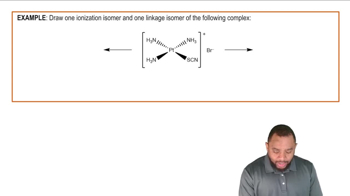
Isomerism refers to the phenomenon where two or more compounds have the same molecular formula but different structural arrangements or spatial orientations of atoms. In the context of fat molecules, isomers can differ in the arrangement of fatty acid chains around the glycerol backbone, leading to variations in physical and chemical properties.
Video consigliato:
Percorso guidato
 2:14
2:14
Isomerism in Coordination Complexes Example
Fatty Acids
Fatty acids are carboxylic acids with long hydrocarbon chains, which can be saturated or unsaturated. In this question, palmitic acid (a saturated fatty acid) and stearic acid (also saturated) are components of the fat molecules. The arrangement of these fatty acids in relation to the glycerol molecule influences the properties of the fat, such as melting point and stability.
Video consigliato:
Percorso guidato
 01:03
01:03Binary Acids
Glycerol Structure
Glycerol is a three-carbon alcohol that serves as the backbone for triglycerides, which are the main constituents of body fat in humans and animals. The structure of glycerol allows it to form ester bonds with fatty acids, resulting in different types of triglycerides. The positioning of the fatty acids on the glycerol molecule is crucial for distinguishing between isomeric forms.
Video consigliato:
Percorso guidato
 01:42
01:42Resonance Structures
Pratica correlata