Ch.3 - Mass Relationships in Chemical Reactions
McMurry - Chemistry 8th Edition
McMurry8th EditionChemistryISBN: 9781292336145Non è quello che usi tu?Cambia libro di testo
Capitolo 3, Problema 4

A can of diet soda contains 180 mg of the low-calorie sugar substitute aspartame (C14H18N2O5). How many molecules of aspartame are in the can of soda? (LO 3.4) (a) 3.7 * 10^23 (b) 3.7 * 10^20 (c) 3.2 * 10^25 (d) 1.2 * 10^22

Guida verificata passo dopo passo
1
Determine the molar mass of aspartame (C_{14}H_{18}N_{2}O_{5}) by adding the atomic masses of all the atoms in the formula.
Convert the mass of aspartame in the can (180 mg) to grams by dividing by 1000.
Calculate the number of moles of aspartame using the formula: \( \text{moles} = \frac{\text{mass in grams}}{\text{molar mass}} \).
Use Avogadro's number (6.022 \(\times\) 10^{23} molecules/mol) to convert the moles of aspartame to molecules by multiplying the number of moles by Avogadro's number.
Compare the calculated number of molecules to the given options to determine the correct answer.

Risposta video verificata per un problema simile:

Questa soluzione video è stata consigliata dai nostri tutor come utile per risolvere questo problema.
Durata del video:
6m

Concetti chiave

Ecco i concetti essenziali che devi comprendere per rispondere correttamente alla domanda.

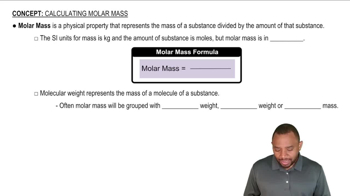
Molar Mass

Molar mass is the mass of one mole of a substance, typically expressed in grams per mole (g/mol). For aspartame (C14H18N2O5), the molar mass can be calculated by summing the atomic masses of all the atoms in its molecular formula. This value is essential for converting between grams of a substance and moles, which is necessary for determining the number of molecules.
Video consigliato:
Percorso guidato
02:11
Molar Mass Concept

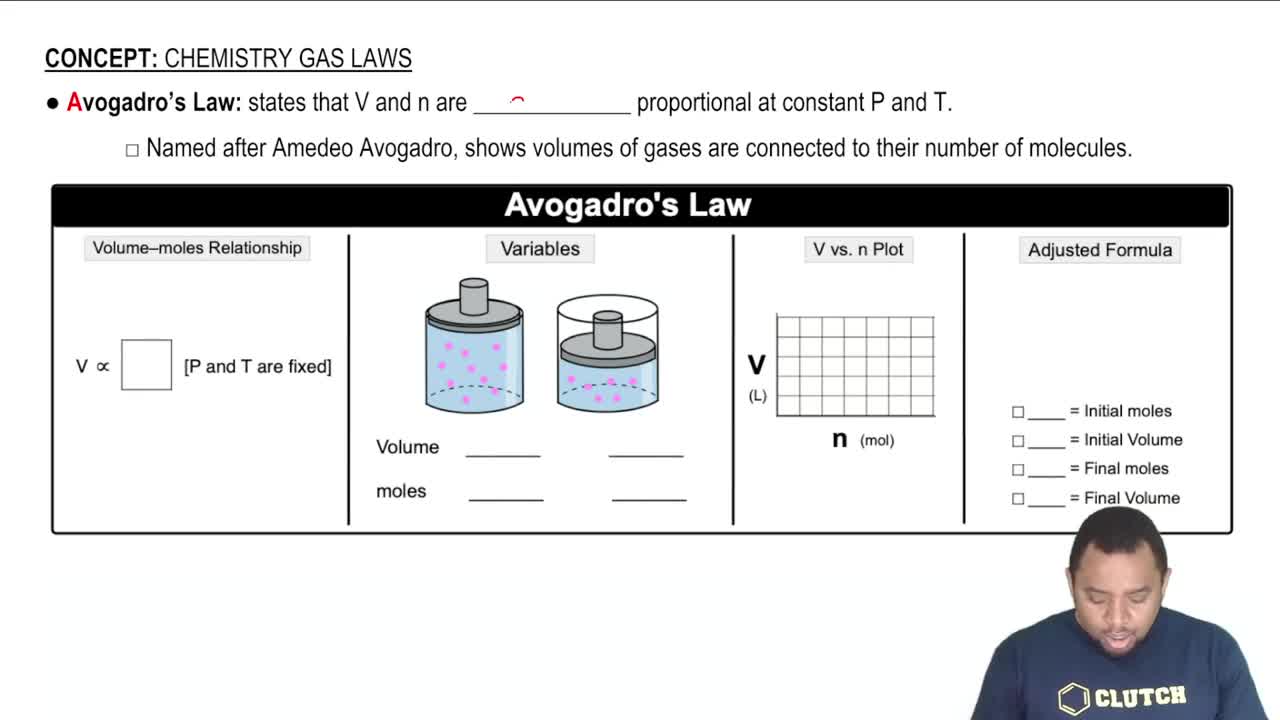
Avogadro's Number

Avogadro's number, approximately 6.022 x 10^23, is the number of atoms, ions, or molecules in one mole of a substance. This constant allows chemists to relate the macroscopic scale of substances (grams) to the microscopic scale (individual molecules). In this problem, it is used to convert the number of moles of aspartame into the actual number of molecules present in the soda.
Video consigliato:

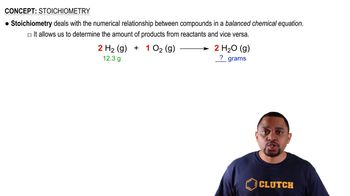
Stoichiometry

Stoichiometry is the branch of chemistry that deals with the quantitative relationships between the reactants and products in a chemical reaction. It involves using balanced chemical equations to calculate the amounts of substances consumed and produced. In this context, stoichiometry helps in determining how many molecules of aspartame correspond to the given mass in the can of soda, facilitating the conversion from grams to molecules.
Video consigliato:
Percorso guidato
01:16
Stoichiometry Concept
Pratica correlata
Domanda del libro di testo

The ball-and-stick molecular model is a representation of caf-feine. Calculate the molecular weight of caffeine. (Gray = C, red = O, blue = N, ivory = H.) (LO 3.3)

(a) 194.2 (b) 182.2 (c) 192.2 (d) 180.2

626
views
Domanda del libro di testo
If 42.85 grams of salicylic acid reacts with excess acetic anhydride and produces 48.47 grams of aspirin, what is the percent yield of the reaction? (LO 3.6) (a) 88.40% (b) 64.69% (c) 86.72% (d) 78.74%
852
views
Domanda del libro di testo
The reaction of A2 (red spheres) with B2 (blue spheres) is shown in the diagram. What is the balanced chemical equa-tion? (LO 3.1) (a) 2 A2 + 6 B2 ---> 4 AB3 (b) 4 A + 12 B ---> 4 AB3 (c) 4 A + 12 B ---> A4 + B12 (d) A2 + 3 B2 ---> 2 AB3
694
views
Domanda del libro di testo

How many moles of chloride ions are in 7.75 g of FeCl3? (LO 3.4) (a) 4.78 * 10^-2 (b) 1.59 * 10^-2 (c) 1.43 * 10^-1 (d) 1.91 * 10^-1

1341
views
Domanda del libro di testo
What are the coefficients in the balanced equation for the combustion of ethanol? (LO 3.2) (a) 1, 3, 2, 3 (b) 2, 3, 4, 3 (c) 2, 7, 4, 6 (d) 1, 4, 2, 3
678
views
1
rank
Domanda del libro di testo
One way to make coal burning better for the environment is to remove carbon dioxide from the exhaust gases released from power plants using a compound containing an amine (-NH2) group. The reaction between carbon dioxide and monoethanolamine is: CO2(g) + 2 HOCH2CH2NH2(aq) -> HOCH2CH2NH3 +(aq) + HOCH2CH2NHCO2-(aq) What mass of monoethanoloamine is required to react with 1.0 kg of carbon dioxide? (LO 3.5) (a) 2.8 kg (b) 1.1 kg (c) 0.93 kg (d) 0.53 kg
673
views