Ch.3 - Mass Relationships in Chemical Reactions
McMurry - Chemistry 8th Edition
McMurry8th EditionChemistryISBN: 9781292336145Non è quello che usi tu?Cambia libro di testo
Capitolo 3, Problema 69

Aluminum reacts with oxygen to yield aluminum oxide. If 5.0 g of Al reacts with 4.45 g of O2, what is the empirical formula of aluminum oxide?

Guida verificata passo dopo passo
1
Step 1: Write the balanced chemical equation for the reaction: 4Al + 3O_2 → 2Al_2O_3.
Step 2: Calculate the moles of aluminum (Al) using its molar mass (26.98 g/mol): moles of Al = mass of Al / molar mass of Al.
Step 3: Calculate the moles of oxygen (O_2) using its molar mass (32.00 g/mol): moles of O_2 = mass of O_2 / molar mass of O_2.
Step 4: Determine the mole ratio of Al to O by dividing the moles of each by the smallest number of moles calculated in the previous steps.
Step 5: Use the mole ratio to determine the empirical formula of aluminum oxide by expressing the ratio in the smallest whole numbers.

Concetti chiave

Ecco i concetti essenziali che devi comprendere per rispondere correttamente alla domanda.

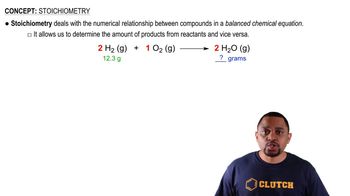
Stoichiometry

Stoichiometry is the branch of chemistry that deals with the quantitative relationships between the reactants and products in a chemical reaction. It allows us to calculate the amounts of substances consumed and produced in a reaction based on balanced chemical equations. Understanding stoichiometry is essential for determining the empirical formula, as it helps in converting masses of reactants to moles and subsequently to the mole ratio of the elements.
Video consigliato:
Percorso guidato
01:16
Stoichiometry Concept

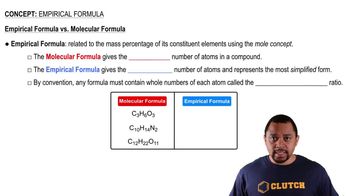
Empirical Formula

The empirical formula of a compound represents the simplest whole-number ratio of the elements present in that compound. It is derived from the mole ratio of the elements obtained from stoichiometric calculations. For aluminum oxide, determining the empirical formula involves finding the ratio of aluminum to oxygen after calculating the moles of each element based on the given masses.
Video consigliato:
Percorso guidato
02:26
Empirical vs Molecular Formula

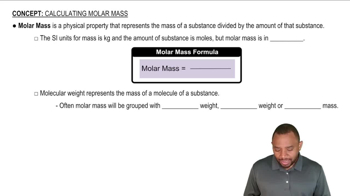
Molar Mass

Molar mass is the mass of one mole of a substance, typically expressed in grams per mole (g/mol). It is crucial for converting between grams and moles in stoichiometric calculations. For this question, knowing the molar masses of aluminum (approximately 27 g/mol) and oxygen (approximately 32 g/mol) allows for the accurate conversion of the given masses of Al and O2 into moles, which is necessary for determining the empirical formula.
Video consigliato:
Percorso guidato
02:11
Molar Mass Concept
Pratica correlata
Domanda del libro di testo

An alternative method for producing hydriodic acid is the reaction of iodine with hydrogen sulfide: H2S + I2 → 2 HI + S (a) How many grams of I2 are needed to react with 49.2 g of H2S?

501
views

Domanda del libro di testo
Silver metal reacts with chlorine (Cl2) to yield silver chlo-ride. If 2.00 g of Ag reacts with 0.657 g of Cl2, what is the empirical formula of silver chloride?
911
views
Domanda del libro di testo
Pure oxygen was first made by heating mercury(II) oxide: HgO --> (heat) Hg + O2 Unbalanced (a) Balance the equation. (b) How many grams of mercury and how many grams of oxygen are formed from 45.5 g of HgO? (c) How many grams of HgO would you need to obtain 33.3 g of O2
783
views
Domanda del libro di testo
The industrial production of hydriodic acid takes place by treatment of iodine with hydrazine (N2H4): 2 I2 + N2H4 --> 4 HI + N2 (b) How many grams of HI are produced from the reaction of 115.7 g of N2H4 with excess iodine
722
views
Domanda del libro di testo

An alternative method for producing hydriodic acid is the reaction of iodine with hydrogen sulfide:H2S + I2 → 2 HI + S (b) How many grams of HI are produced from the reaction of 95.4 g of H2S with excess I2?

461
views
Domanda del libro di testo
Titanium dioxide (TiO2), the substance used as the pigment in white paint, is prepared industrially by reaction of TiCl4 with O2 at high temperature. TiCl4 + O2 --> (heat) TiO2 + 2 Cl2 How many kilograms of TiO2 can be prepared from 5.60 kg of TiCl4?
1768
views