Ch.3 - Mass Relationships in Chemical Reactions
McMurry - Chemistry 8th Edition
McMurry8th EditionChemistryISBN: 9781292336145Non è quello che usi tu?Cambia libro di testo
Capitolo 3, Problema 92

An unknown liquid is composed of 5.57% H, 28.01% Cl, and 66.42% C. The molecular weight found by mass spectrometry is 126.58. What is the molecular formula of the compound?

Guida verificata passo dopo passo
1
Calculate the moles of each element in 100 g of the compound: For H, Cl, and C, use their respective percentages and atomic masses (H: 1.01 g/mol, Cl: 35.45 g/mol, C: 12.01 g/mol).
Determine the mole ratio of the elements by dividing each element's moles by the smallest number of moles calculated in the previous step.
Use the mole ratio to find the empirical formula of the compound.
Calculate the empirical formula mass by adding the atomic masses of the elements in the empirical formula.
Determine the molecular formula by dividing the given molecular weight (126.58 g/mol) by the empirical formula mass, and multiply the subscripts in the empirical formula by this ratio.

Risposta video verificata per un problema simile:

Questa soluzione video è stata consigliata dai nostri tutor come utile per risolvere questo problema.
Durata del video:
5m

Concetti chiave

Ecco i concetti essenziali che devi comprendere per rispondere correttamente alla domanda.

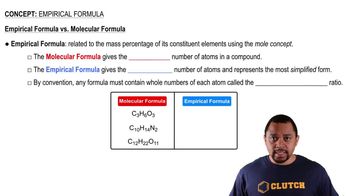
Empirical Formula

The empirical formula represents the simplest whole-number ratio of the elements in a compound. To determine it, the percentage composition of each element is converted to moles, and the ratios are simplified. This formula provides insight into the basic composition of the compound, which is essential for further calculations.
Video consigliato:
Percorso guidato
02:26
Empirical vs Molecular Formula

Molecular Weight

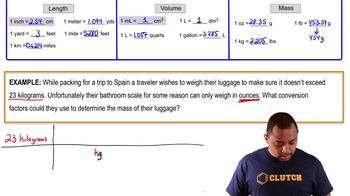
Molecular weight, or molar mass, is the mass of one mole of a substance, typically expressed in grams per mole (g/mol). It is determined by summing the atomic weights of all atoms in a molecule. Knowing the molecular weight allows for the conversion between mass and moles, which is crucial for identifying the molecular formula from the empirical formula.
Video consigliato:
Percorso guidato
03:45
Weight Conversion Example

Molecular Formula

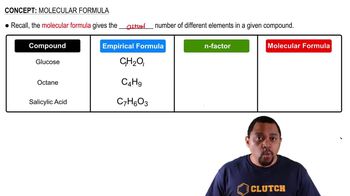
The molecular formula indicates the actual number of atoms of each element in a molecule of a compound. It can be derived from the empirical formula by multiplying the subscripts by a whole number, which is determined by the ratio of the molecular weight to the empirical formula weight. This formula provides a complete picture of the compound's composition.
Video consigliato:
Percorso guidato
02:08
Determining Molecular Formulas