Ch.3 - Mass Relationships in Chemical Reactions
McMurry - Chemistry 8th Edition
McMurry8th EditionChemistryISBN: 9781292336145Non è quello che usi tu?Cambia libro di testo
Capitolo 3, Problema 38c

Balance the following equations. (c) S + O2 → SO3

Guida verificata passo dopo passo
1
Identify the number of each type of atom on both sides of the equation. On the left, you have 1 sulfur (S) atom and 2 oxygen (O) atoms. On the right, you have 1 sulfur (S) atom and 3 oxygen (O) atoms.
Notice that the sulfur atoms are already balanced with 1 sulfur atom on each side.
Focus on balancing the oxygen atoms. You have 2 oxygen atoms on the left and 3 on the right. To balance the oxygen atoms, you need to have the same number on both sides.
To balance the oxygen atoms, you can multiply the O2 molecule on the left by 3 and the SO3 molecule on the right by 2, giving you 3 O2 molecules and 2 SO3 molecules.
Now, adjust the sulfur atoms to match the new coefficients. You will need 2 sulfur atoms on the left to balance the 2 SO3 molecules on the right.

Risposta video verificata per un problema simile:

Questa soluzione video è stata consigliata dai nostri tutor come utile per risolvere questo problema.
Durata del video:
59s

Concetti chiave

Ecco i concetti essenziali che devi comprendere per rispondere correttamente alla domanda.

Balancing Chemical Equations

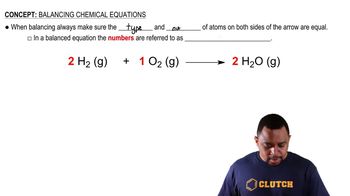
Balancing chemical equations involves ensuring that the number of atoms of each element is the same on both sides of the equation. This is based on the law of conservation of mass, which states that matter cannot be created or destroyed in a chemical reaction. Coefficients are used to adjust the quantities of reactants and products to achieve balance.
Video consigliato:
Percorso guidato
01:32
Balancing Chemical Equations

Stoichiometry

Stoichiometry is the study of the quantitative relationships between the amounts of reactants and products in a chemical reaction. It allows chemists to predict how much of each substance is needed or produced in a reaction. Understanding stoichiometry is essential for balancing equations, as it provides the ratios in which substances react and form.
Video consigliato:
Percorso guidato
01:16
Stoichiometry Concept

Combustion Reactions

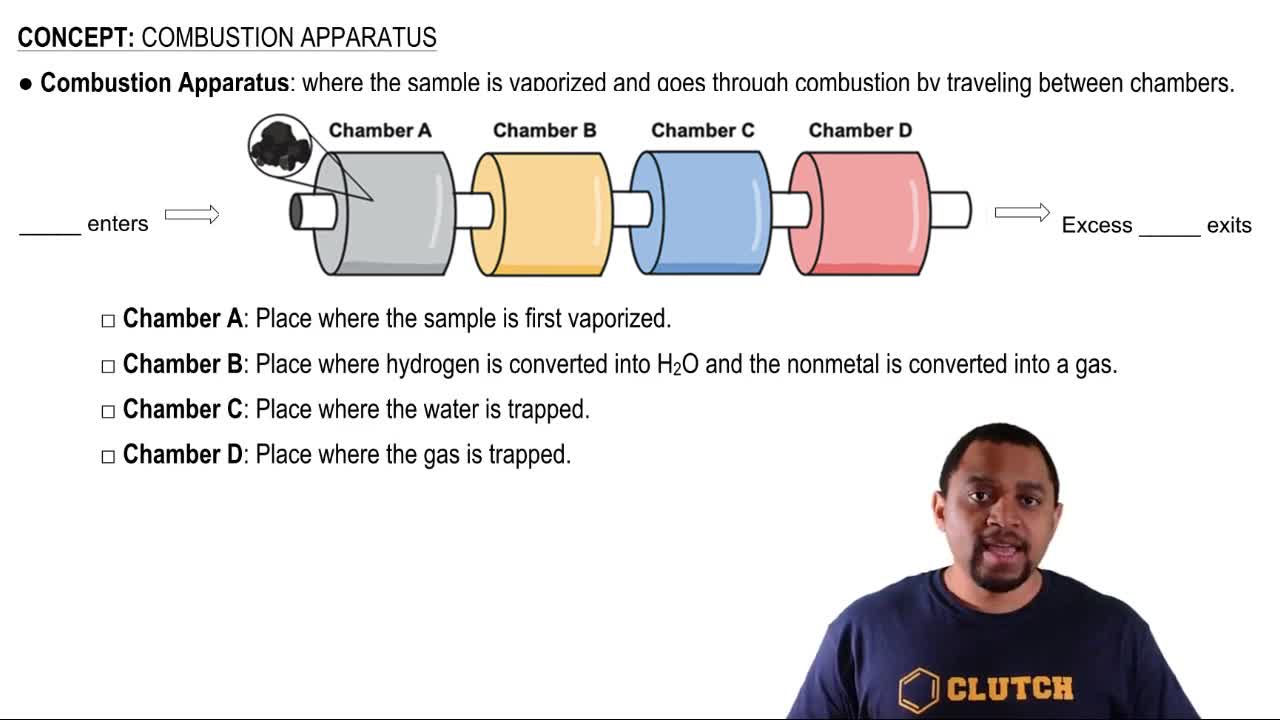
Combustion reactions typically involve a substance reacting with oxygen to produce energy, carbon dioxide, and water. In the case of sulfur reacting with oxygen, the product is sulfur trioxide (SO3). Recognizing the type of reaction helps in predicting the products and understanding the balancing process, as different reactions may have specific patterns.
Video consigliato:
Percorso guidato
02:24
Combustion Apparatus