
Ch.3 - Mass Relationships in Chemical Reactions
McMurry - Chemistry 8th Edition
McMurry8th EditionChemistryISBN: 9781292336145Non è quello che usi tu?Cambia libro di testo
Capitolo 3, Problema 81

Cisplatin [Pt(NH3)2Cl2], a compound used in cancer treat-ment, is prepared by reaction of ammonia with potassium tetrachloroplatinate: K2PtCl4 + 2 NH3 ----> 2 KCl + Pt(NH3)2Cl2 How many grams of cisplatin are formed from 55.8 g of K2PtCl4 and 35.6 g of NH3 if the reaction takes place in 95% yield based on the limiting reactant?

Guida verificata passo dopo passo
1
Calculate the molar mass of K2PtCl4 and NH3 using the periodic table.
Convert the given masses of K2PtCl4 and NH3 to moles by dividing by their respective molar masses.
Determine the limiting reactant by comparing the mole ratio of K2PtCl4 to NH3 with the stoichiometric ratio from the balanced equation.
Use the moles of the limiting reactant to calculate the theoretical yield of cisplatin (Pt(NH3)2Cl2) in moles, based on the stoichiometry of the reaction.
Convert the theoretical yield in moles to grams using the molar mass of cisplatin, and then multiply by the reaction yield (95%) to find the actual yield in grams.

Risposta video verificata per un problema simile:

Questa soluzione video è stata consigliata dai nostri tutor come utile per risolvere questo problema.
Durata del video:
6m

Concetti chiave

Ecco i concetti essenziali che devi comprendere per rispondere correttamente alla domanda.

Stoichiometry

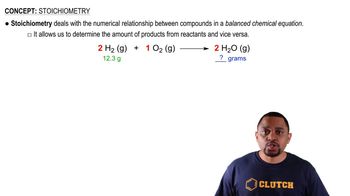
Stoichiometry is the calculation of reactants and products in chemical reactions based on the balanced chemical equation. It involves using mole ratios derived from the coefficients of the balanced equation to determine how much of each substance is consumed or produced. In this case, stoichiometry will help identify the limiting reactant and calculate the theoretical yield of cisplatin.
Video consigliato:
Percorso guidato
01:16
Stoichiometry Concept

Limiting Reactant

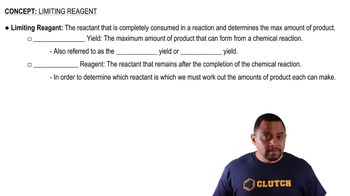
The limiting reactant is the substance that is completely consumed first in a chemical reaction, thus determining the maximum amount of product that can be formed. To find the limiting reactant, one must compare the mole ratios of the reactants based on the balanced equation. In this scenario, identifying the limiting reactant is crucial for calculating the actual yield of cisplatin.
Video consigliato:
Percorso guidato
01:30
Limiting Reagent Concept

Percent Yield

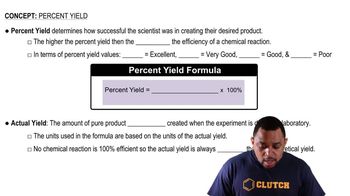
Percent yield is a measure of the efficiency of a chemical reaction, calculated as the ratio of the actual yield to the theoretical yield, multiplied by 100. It indicates how much product was obtained compared to what was expected based on stoichiometric calculations. In this problem, the 95% yield indicates that only 95% of the theoretical amount of cisplatin will be produced, which must be factored into the final calculation.
Video consigliato:
Percorso guidato
03:09
Percent Yield in Reactions
Pratica correlata
Domanda del libro di testo
Acetic acid (CH3CO2H) reacts with isopentyl alcohol (C5H12O) to yield isopentyl acetate (C7H14O2), a fragrant substance with the odor of bananas. If the yield from the reaction of acetic acid with isopentyl alcohol is 45%, how many grams of isopentyl acetate are formed from 3.58 g of acetic acid and 4.75 g of isopentyl alcohol? The reaction is CH3CO2H + C5H12O ---> C7H14O2 + H2O
2262
views
Domanda del libro di testo
Sodium azide (NaN3) yields N2 gas when heated to 300 °C, a reaction used in automobile air bags. If 1.00 mol of N2 has a volume of 47.0 L under the reaction conditions, how many liters of gas can be formed by heating 38.5 g of NaN3? The reaction is
1444
views
Domanda del libro di testo

Limestone (CaCO3) reacts with hydrochloric acid according to the equation CaCO3 + 2 HCl ---> CaCl2 + H2O + CO2. If 1.00 mol of CO2 has a volume of 22.4 L under the reaction conditions, how many liters of gas can be formed by reaction of 2.35 g of CaCO3 with 2.35 g of HCl? Which reactant is limiting?

6286
views
1
rank
Domanda del libro di testo

The reaction of tungsten hexachloride (WCl6) with bismuth gives hexatungsten dodecachloride (W6Cl12).

WCl6 + Bi → W6Cl12 + BiCl3 Unbalanced

(a) Balance the equation.

765
views
Domanda del libro di testo
If 1.87 g of acetic acid (CH3COOH) reacts with 2.31 g of isopentyl alcohol (C5H12O) to give 2.96 g of isopentyl acetate (C7H14O2), what is the percent yield of the reaction?
809
views
Domanda del libro di testo
If 3.42 g of K2PtCl4 and 1.61 g of NH3 give 2.08 g of cispla-tin (Problem 3.81), what is the percent yield of the reaction?
603
views