Ch.3 - Mass Relationships in Chemical Reactions
McMurry - Chemistry 8th Edition
McMurry8th EditionChemistryISBN: 9781292336145Non è quello che usi tu?Cambia libro di testo
Capitolo 3, Problema 47

The following pictures represent equilibrium mixtures at 325 K and 350 K for a reaction involving A atoms (red), B atoms (blue), and AB molecules. (a) Write a balanced equation for the reaction that occurs on raising the temperature.

Guida verificata passo dopo passo
1
Identify the components involved in the reaction: A atoms (red), B atoms (blue), and AB molecules.
Determine the initial and final states of the reaction at the given temperatures (325 K and 350 K) by analyzing the pictures.
Observe the change in the number of A atoms, B atoms, and AB molecules as the temperature increases from 325 K to 350 K.
Write the balanced chemical equation based on the observed changes, ensuring that the number of atoms of each element is conserved.
Consider the direction of the reaction that is favored by the increase in temperature, indicating whether the reaction is endothermic or exothermic.

Risposta video verificata per un problema simile:

Questa soluzione video è stata consigliata dai nostri tutor come utile per risolvere questo problema.
Durata del video:
1m

Concetti chiave

Ecco i concetti essenziali che devi comprendere per rispondere correttamente alla domanda.

Chemical Equilibrium

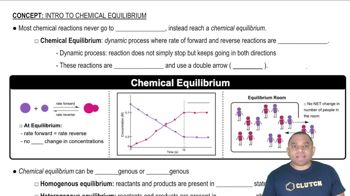
Chemical equilibrium occurs when the rates of the forward and reverse reactions are equal, resulting in constant concentrations of reactants and products. In this state, the system is dynamic, meaning that reactions continue to occur, but there is no net change in the concentrations. Understanding this concept is crucial for analyzing how changes in conditions, such as temperature, affect the position of equilibrium.
Video consigliato:
Percorso guidato
04:21
Chemical Equilibrium Concepts

Le Chatelier's Principle

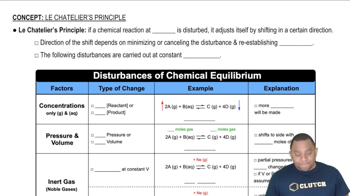
Le Chatelier's Principle states that if a dynamic equilibrium is disturbed by changing the conditions, the system will adjust to counteract the change and restore a new equilibrium. For example, increasing the temperature of an exothermic reaction will shift the equilibrium position to favor the endothermic direction, thus affecting the concentrations of reactants and products. This principle is essential for predicting the effects of temperature changes on chemical reactions.
Video consigliato:
Percorso guidato
07:32
Le Chatelier's Principle

Balanced Chemical Equation

A balanced chemical equation represents a chemical reaction with equal numbers of each type of atom on both sides of the equation, adhering to the law of conservation of mass. Balancing equations is crucial for understanding the stoichiometry of reactions, which informs how reactants convert to products. In the context of the question, writing a balanced equation for the reaction at different temperatures requires knowledge of the reactants and products involved.
Video consigliato:
Percorso guidato
01:32
Balancing Chemical Equations