Ch.3 - Mass Relationships in Chemical Reactions
McMurry - Chemistry 8th Edition
McMurry8th EditionChemistryISBN: 9781292336145Non è quello che usi tu?Cambia libro di testo
Capitolo 3, Problema 44c

What are the molecular (formula) weights of the following substances? (c) CF2Cl2 (a chlorofluorocarbon that destroys the stratospheric ozone layer

Guida verificata passo dopo passo
1
Identify the atomic masses of each element in CF2Cl2 from the periodic table. Carbon (C) has an atomic mass of approximately 12.01 g/mol, Fluorine (F) has an atomic mass of approximately 19.00 g/mol, and Chlorine (Cl) has an atomic mass of approximately 35.45 g/mol.
Multiply the atomic mass of each element by the number of atoms of that element in the molecule. For CF2Cl2, this means: Carbon: 1 atom × 12.01 g/mol, Fluorine: 2 atoms × 19.00 g/mol, Chlorine: 2 atoms × 35.45 g/mol.
Add the results from the previous step to find the total molecular weight of CF2Cl2. This involves adding the contributions from carbon, fluorine, and chlorine.
Ensure the units are consistent throughout the calculation, using grams per mole (g/mol) as the unit for molecular weight.
Double-check the calculation for any possible errors in multiplication or addition to ensure the accuracy of the molecular weight.

Risposta video verificata per un problema simile:

Questa soluzione video è stata consigliata dai nostri tutor come utile per risolvere questo problema.
Durata del video:
2m

Concetti chiave

Ecco i concetti essenziali che devi comprendere per rispondere correttamente alla domanda.

Molecular Weight

Molecular weight, or molar mass, is the mass of one mole of a substance, typically expressed in grams per mole (g/mol). It is calculated by summing the atomic weights of all atoms in a molecule, which can be found on the periodic table. Understanding molecular weight is essential for stoichiometry, as it allows for the conversion between grams and moles in chemical reactions.
Video consigliato:
Percorso guidato
03:45
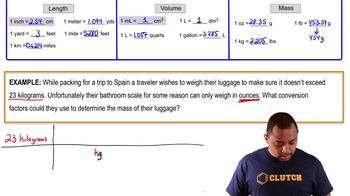
Weight Conversion Example

Chemical Formula

A chemical formula represents the composition of a molecule, indicating the types and numbers of atoms present. For example, CF2Cl2 indicates that the molecule contains one carbon (C) atom, two fluorine (F) atoms, and two chlorine (Cl) atoms. Recognizing how to interpret chemical formulas is crucial for determining molecular weights and understanding the properties of substances.
Video consigliato:
Percorso guidato
02:26
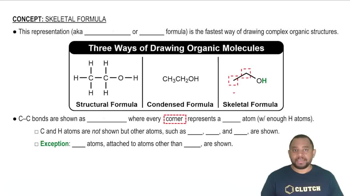
Skeletal Formula

Periodic Table

The periodic table is a tabular arrangement of chemical elements, organized by increasing atomic number and grouped by similar properties. Each element has a unique atomic weight, which is essential for calculating molecular weights. Familiarity with the periodic table allows students to quickly find the necessary atomic weights needed to compute the molecular weight of compounds like CF2Cl2.
Video consigliato:
Percorso guidato
02:40
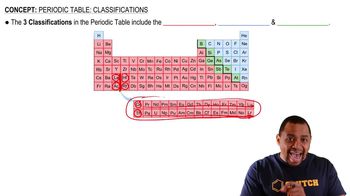
Periodic Table Classifications