What are the empirical formulas of each of the following substances? (c) Zircon, a mineral from which cubic zirconia is made: 34.91% O, 15.32% Si, 49.77% Zr
Ch.3 - Mass Relationships in Chemical Reactions
Capitolo 3, Problema 90
What is the empirical formula of stannous fluoride, the first fluoride compound added to toothpaste to protect teeth against decay? Its mass percent composition is 24.25% F, 75.75% Sn.
Guida verificata passo dopo passo1
Identify the elements present in the compound: Fluorine (F) and Tin (Sn).
Convert the mass percentages to grams, assuming a 100 g sample: 24.25 g of F and 75.75 g of Sn.
Convert the masses to moles using the molar masses: \( \text{Molar mass of F} = 19.00 \, \text{g/mol} \) and \( \text{Molar mass of Sn} = 118.71 \, \text{g/mol} \).
Calculate the mole ratio by dividing the moles of each element by the smallest number of moles calculated.
Write the empirical formula using the mole ratio as subscripts for each element.

Risposta video verificata per un problema simile:
Questa soluzione video è stata consigliata dai nostri tutor come utile per risolvere questo problema.
Durata del video:
1mConcetti chiave
Ecco i concetti essenziali che devi comprendere per rispondere correttamente alla domanda.
Empirical Formula
The empirical formula of a compound represents the simplest whole-number ratio of the elements present in that compound. It is derived from the mass percent composition of the elements, allowing chemists to understand the basic composition without detailing the molecular structure.
Video consigliato:
Percorso guidato
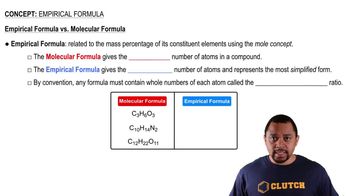
Empirical vs Molecular Formula
Mass Percent Composition
Mass percent composition indicates the percentage by mass of each element in a compound. It is calculated by dividing the mass of each element by the total mass of the compound and multiplying by 100. This information is crucial for determining the empirical formula.
Video consigliato:
Percorso guidato
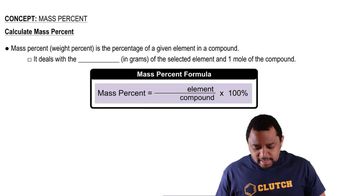
Mass Percent Calculation
Molar Mass
Molar mass is the mass of one mole of a substance, typically expressed in grams per mole (g/mol). It is essential for converting between mass and moles, which is necessary when calculating the empirical formula from mass percent composition, as it helps to determine the number of moles of each element present.
Video consigliato:
Percorso guidato
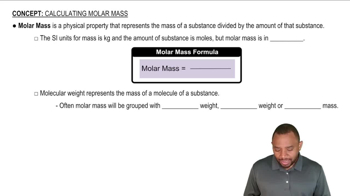
Molar Mass Concept
Pratica correlata
Domanda del libro di testo
808
views
Domanda del libro di testo
What are the empirical formulas of substances with the following mass percent compositions? (b) Ilmenite (a titanium-containing ore): 31.63% O, 31.56% Ti, 36.81% Fe
764
views
Domanda del libro di testo
Ferrocene, a substance proposed for use as a gasoline additive, has the percent composition 5.42% H, 64.56% C, and 30.02% Fe. What is the empirical formula of ferrocene?
687
views
Domanda del libro di testo
What are the empirical formulas of substances with the following mass percent compositions? (c) Sodium thiosulfate (photographic 'fixer'): 30.36% O, 29.08% Na, 40.56% S
791
views
Domanda del libro di testo
What are the empirical formulas of each of the following substances? (b) Magnetite, a naturally occurring magnetic mineral: 72.36% Fe, 27.64% O
741
views
Domanda del libro di testo
What are the empirical formulas of each of the following substances? (a) Ibuprofen, a headache remedy: 75.69% C, 15.51% O, 8.80% H
647
views