

Ch.3 - Mass Relationships in Chemical Reactions
McMurry - Chemistry 8th Edition
McMurry8th EditionChemistryISBN: 9781292336145Non è quello che usi tu?Cambia libro di testo
Capitolo 3, Problema 11

What is the percent composition by mass of Mn in potas-sium permanganate, KMnO4? (LO 3.10) (a) 22.6% (b) 34.8% (c) 49.9% (d) 54.9%

Guida verificata passo dopo passo
1
Determine the molar mass of each element in potassium permanganate (KMnO_4): K, Mn, and O.
Calculate the molar mass of KMnO_4 by adding the molar masses of all the atoms in the formula.
Identify the molar mass of Mn from the periodic table.
Calculate the percent composition by mass of Mn using the formula: (molar mass of Mn / molar mass of KMnO_4) * 100%.
Compare the calculated percent composition with the given options to identify the correct answer.

Risposta video verificata per un problema simile:

Questa soluzione video è stata consigliata dai nostri tutor come utile per risolvere questo problema.
Durata del video:
3m

Concetti chiave

Ecco i concetti essenziali che devi comprendere per rispondere correttamente alla domanda.

Molar Mass Calculation

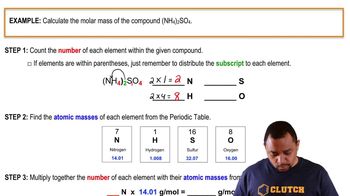
Molar mass is the mass of one mole of a substance, typically expressed in grams per mole (g/mol). To find the molar mass of a compound, you sum the atomic masses of all the atoms in its chemical formula. For potassium permanganate (KMnO4), you would calculate the molar mass by adding the atomic masses of potassium (K), manganese (Mn), and four oxygen (O) atoms.
Video consigliato:
Percorso guidato
03:12
Molar Mass Calculation Example

Percent Composition

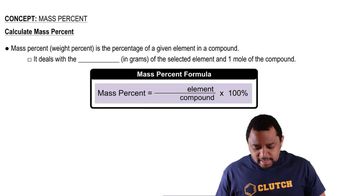
Percent composition by mass refers to the percentage of a specific element in a compound relative to the total mass of the compound. It is calculated using the formula: (mass of the element in 1 mole of the compound / molar mass of the compound) x 100%. This concept is essential for determining how much of a compound's mass is contributed by a particular element.
Video consigliato:
Percorso guidato
00:38
Mass Percent Calculation

Stoichiometry

Stoichiometry is the area of chemistry that deals with the relationships between the quantities of reactants and products in chemical reactions. It allows chemists to predict the amounts of substances consumed and produced in a reaction. Understanding stoichiometry is crucial for accurately calculating percent compositions and performing other quantitative analyses in chemistry.
Video consigliato:
Percorso guidato
01:16
Stoichiometry Concept
Pratica correlata
Domanda del libro di testo
Lactic acid forms in muscle tissue after strenuous exercise. Elemental analysis shows that lactic acid is 40.0% carbon, 6.71% hydrogen, and 53.3% oxygen by mass. If the molec-ular weight of lactic acid is 90.08, what is the molecular for-mula? (LO 3.11) (a) CH2O (b) C3H6O3 (c) C4H8O4 (d) C4H10O2
1189
views
Domanda del libro di testo

Combustion analysis is performed on 0.50 g of a hydrocar-bon and 1.55 g of CO2, and 0.697 g of H2O are produced. The mass spectrum for the hydrocarbon is provided below. What is the molecular formula? (LO 3.12 and 3.13)

(a) C5H11 (b) C8H18 (c) C11H10 (d) C10H22

613
views
Domanda del libro di testo

Silver sulfide, the tarnish on silverware, comes from the reaction of silver metal with hydrogen sulfide (H2S).The unbalanced equation is: Ag + H2S + O2 --> Ag2S + H2O Unbalanced If the reaction was used intentionally to prepare Ag2S, how many grams would be formed from 496 g of Ag, 80.0 g of H2S, and excess O2 if the reaction takes place in 90% yield? (LO 3.9) (a) 525 g (b) 1139 g (c) 583 g (d) 1025

1742
views
Domanda del libro di testo
If 2.00 moles of nitrogen and 5.50 moles of hydrogen are placed in a reaction vessel and react to form ammonia, what is the theoretical yield of ammonia (NH3)? (LO 3.8) N2(g) + 3 H2(g) --> 2 NH3(g) (a) 31.2 g (b) 62.3 g (c) 93.7 g (d) 34.1
878
views
Domanda del libro di testo

Dimethylhydrazine, a colorless liquid used as a rocket fuel, is 40.0% C, 13.3% H, and 46.7% N. What is the empirical formula? (LO 3.11) (a) CH4N9 (b) CH2N (c) C2H4N (d) C2H5N2

1050
views
Domanda del libro di testo
The diagram represents a mixture of AB2 and B2 before it reacts to form AB3. (Red spheres = A, blue spheres = B.) Which reactant is limiting, and how many AB3 molecules are formed? (LO 3.7)

(a) B2 is limiting, and 10 molecules of AB3 are formed. (b) B2 is limiting, and 4 molecules of AB3 are formed. (c) AB2 is limiting, and 6 molecules of AB3 are formed. (d) AB2 is limiting, and 4 molecules of AB3 are formed
571
views