
Ch.4 - Reactions in Aqueous Solution
McMurry - Chemistry 8th Edition
McMurry8th EditionChemistryISBN: 9781292336145Non è quello che usi tu?Cambia libro di testo
Capitolo 4, Problema 143

A sample of metal (M) reacted with both steam and aqueous HCl to release H2 but did not react with water at room tem-perature. When 1.000 g of the metal was burned in oxygen, it formed 1.890 g of a metal oxide, M2O3. What is the iden-tity of the metal?

Guida verificata passo dopo passo
1
Determine the molar mass of the metal oxide, M2O3, using the given mass of the metal and the mass of the metal oxide formed.
Calculate the mass of oxygen in the metal oxide by subtracting the mass of the metal from the mass of the metal oxide.
Use the molar mass of oxygen to find the number of moles of oxygen in the metal oxide.
Since the formula of the metal oxide is M2O3, use the mole ratio to find the number of moles of the metal in the oxide.
Calculate the molar mass of the metal by dividing the mass of the metal by the number of moles of the metal, and compare it to known molar masses to identify the metal.

Risposta video verificata per un problema simile:

Questa soluzione video è stata consigliata dai nostri tutor come utile per risolvere questo problema.
Durata del video:
12m

Concetti chiave

Ecco i concetti essenziali che devi comprendere per rispondere correttamente alla domanda.

Reactivity of Metals

The reactivity of metals varies significantly, with some metals reacting readily with water, steam, or acids, while others do not. In this case, the metal (M) reacts with steam and hydrochloric acid to produce hydrogen gas (H2), indicating it is a reactive metal, but it does not react with water at room temperature, suggesting it is less reactive than alkali or alkaline earth metals.
Video consigliato:
Percorso guidato
03:12
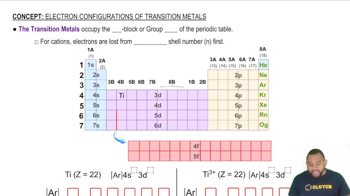
Transition Metals

Stoichiometry and Molar Mass

Stoichiometry involves the calculation of reactants and products in chemical reactions. The formation of the metal oxide M2O3 from the metal (M) allows us to determine the molar mass of the metal by using the mass of the metal burned (1.000 g) and the mass of the resulting oxide (1.890 g) to find the ratio of metal to oxygen in the compound.
Video consigliato:
Percorso guidato
02:11
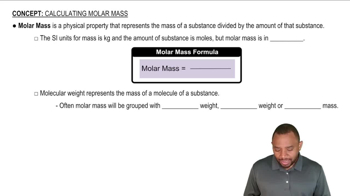
Molar Mass Concept

Oxidation States and Metal Oxides

Metal oxides are compounds formed when metals react with oxygen, and the oxidation state of the metal in the oxide can provide clues to its identity. In M2O3, the metal (M) has an oxidation state of +3, which is characteristic of certain metals, helping to narrow down the possible identity of the metal based on its known oxidation states.
Video consigliato:
Percorso guidato
00:58
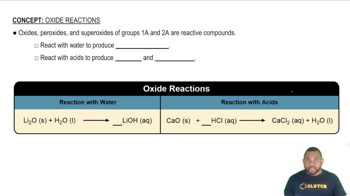
Oxide Reactions
Pratica correlata
Domanda del libro di testo
Iron content in ores can be determined by a redox procedure in which the sample is first reduced with Sn2+, as in Problem 4.130, and then titrated with KMnO4 to oxidize the Fe2+ to Fe3+. The balanced equation is What is the mass percent Fe in a 2.368 g sample if 48.39 mL of a 0.1116 M KMnO4 solution is needed to titrate the Fe3 + ?
306
views
Domanda del libro di testo

(b) If Ksp = 1.1 * 10-12 for Ag2CrO4, what are the molar concentrations of Ag+ and CrO4 2-in solution?

520
views
Domanda del libro di testo
A sample weighing 14.98 g and containing a small amount of copper was treated to give a solution containing aque-ous Cu2+ ions. Sodium iodide was then added to yield solid copper(I) iodide plus I3 with thiosulfate, S2O3 - ion, and the I3 - was titrated 2-. The titration required 10.49 mL of 0.100 M Na2S2O3 for complete reaction. What is the mass percent copper in the sample? The balanced equations are
355
views
Domanda del libro di testo
A mixture of acetic acid (CH3CO2H; monoprotic) and oxalic acid (H2C2O4; diprotic) requires 27.15 mL of 0.100 M NaOH to neutralize it. When an identical amount of the mixture is titrated, 15.05 mL of 0.0247 M KMnO4 is needed for complete reaction. What is the mass percent of each acid in the mixture? (Acetic acid does not react with MnO4 equation for the reaction of oxalic acid with MnO4 given in Problem 4.133.)
1110
views
Domanda del libro di testo
A 100.0 mL solution containing aqueous HCl and HBr was titrated with 0.1235 M NaOH. The volume of base required to neutralize the acid was 47.14 mL. Aqueous AgNO3 was then added to precipitate the Cl-and Br-ions as AgCl and AgBr. The mass of the silver halides obtained was 0.9974 g. What are the molarities of the HCl and HBr in the original solution?
795
views
1
comments
Domanda del libro di testo
An unknown metal (M) was found not to react with either water or steam, but its reactivity with aqueous acid was not investigated. When a 1.000 g sample of the metal was burned in oxygen and the resulting metal oxide converted to a metal sulfide, 1.504 g of sulfide was obtained. What is the identity of the metal?
410
views