
Ch.4 - Reactions in Aqueous Solution
McMurry - Chemistry 8th Edition
McMurry8th EditionChemistryISBN: 9781292336145Non è quello che usi tu?Cambia libro di testo
Capitolo 4, Problema 65

A solution of HCl in water conducts electricity, but a solu-tion of HCl in chloroform, CHCl3, does not. What does this observation tell you about how HCl exists in water and how it exists in chloroform?

Guida verificata passo dopo passo
1
Identify the key difference between water and chloroform as solvents: Water is a polar solvent, while chloroform is a non-polar solvent.
Understand that HCl is a strong acid and dissociates completely in water to form H⁺ and Cl⁻ ions, which are responsible for conducting electricity.
Recognize that in a non-polar solvent like chloroform, HCl does not dissociate into ions because the solvent cannot stabilize the ions effectively.
Conclude that the ability of a solution to conduct electricity depends on the presence of free ions, which are present in the aqueous solution but not in the chloroform solution.
Summarize that HCl exists as dissociated ions in water, allowing for electrical conductivity, whereas in chloroform, it remains as neutral HCl molecules, preventing conductivity.

Risposta video verificata per un problema simile:

Questa soluzione video è stata consigliata dai nostri tutor come utile per risolvere questo problema.
Durata del video:
1m

Concetti chiave

Ecco i concetti essenziali che devi comprendere per rispondere correttamente alla domanda.

Electrolytes and Conductivity

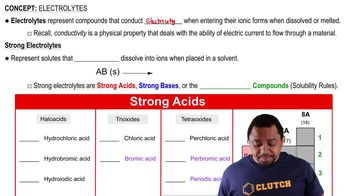
Electrolytes are substances that dissociate into ions when dissolved in a solvent, allowing the solution to conduct electricity. Strong acids like HCl fully ionize in water, producing H⁺ and Cl⁻ ions, which facilitate electrical conductivity. In contrast, non-polar solvents like chloroform do not support ionization, resulting in poor conductivity.
Video consigliato:
Percorso guidato
02:50
Electrolytes and Strong Acids

Solvent Polarity

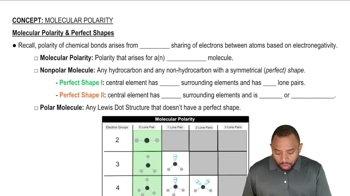
The polarity of a solvent significantly affects the solubility and behavior of solutes. Water is a polar solvent, which stabilizes ions through solvation, allowing ionic compounds to dissolve and dissociate. Chloroform, being non-polar, does not effectively solvate ions, leading to the conclusion that HCl remains largely undissociated in this medium.
Video consigliato:
Percorso guidato
02:38
Molecular Polarity

Dissociation of Acids

The dissociation of acids refers to the process by which an acid releases protons (H⁺ ions) in solution. HCl is a strong acid that completely dissociates in water, contributing to its conductivity. However, in chloroform, HCl does not dissociate significantly, indicating that the chemical environment influences the acid's behavior and ionization.
Video consigliato:
Percorso guidato
00:54
Acid-Base Dissociation Example