Ch.4 - Reactions in Aqueous Solution
McMurry - Chemistry 8th Edition
McMurry8th EditionChemistryISBN: 9781292336145Non è quello che usi tu?Cambia libro di testo
Capitolo 4, Problema 111a

Assign oxidation numbers to each element in the following ions. (a) Cr(OH)4-

Guida verificata passo dopo passo
1
Identify the overall charge of the ion, which is -1 for \( \text{Cr(OH)}_4^- \).
Assign oxidation numbers to the known elements: Oxygen (O) typically has an oxidation number of -2, and Hydrogen (H) is usually +1.
Calculate the total contribution of the oxidation numbers from the four hydroxide ions (OH). Each OH group contributes -1 to the overall charge: \( 4 \times (-1) = -4 \).
Let the oxidation number of Chromium (Cr) be \( x \). Set up the equation based on the sum of oxidation numbers equaling the charge of the ion: \( x + 4(-1) = -1 \).
Solve the equation for \( x \) to find the oxidation number of Chromium (Cr).

Risposta video verificata per un problema simile:

Questa soluzione video è stata consigliata dai nostri tutor come utile per risolvere questo problema.
Durata del video:
3m

Concetti chiave

Ecco i concetti essenziali che devi comprendere per rispondere correttamente alla domanda.

Oxidation Numbers

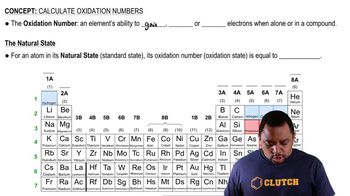
Oxidation numbers are a way to keep track of electrons in chemical compounds. They indicate the degree of oxidation of an atom in a molecule, helping to determine how electrons are transferred during reactions. The oxidation number of an element can be positive, negative, or zero, depending on its electron gain or loss relative to its elemental state.
Video consigliato:
Percorso guidato
02:42
Oxidation Numbers

Rules for Assigning Oxidation Numbers

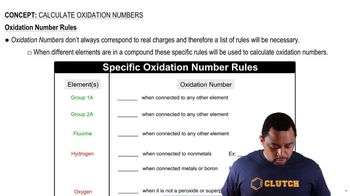
There are specific rules for assigning oxidation numbers, such as: the oxidation number of an atom in its elemental form is zero, the oxidation number of a monoatomic ion is equal to its charge, and in compounds, the sum of oxidation numbers must equal the overall charge of the molecule or ion. For example, in hydroxide (OH-), oxygen typically has an oxidation number of -2, which helps in determining the oxidation state of other elements.
Video consigliato:
Percorso guidato
03:13
Oxidation Number Rules

Polyatomic Ions

Polyatomic ions are ions composed of two or more atoms that are covalently bonded and carry a net charge. Understanding the structure and charge of polyatomic ions, such as hydroxide (OH-), is crucial for assigning oxidation numbers in compounds. In the case of Cr(OH)4-, recognizing that the hydroxide group contributes a charge of -1 is essential for calculating the oxidation state of chromium.
Video consigliato:
Percorso guidato
01:20
Polyatomic Ion Variations