
Ch.4 - Reactions in Aqueous Solution
McMurry - Chemistry 8th Edition
McMurry8th EditionChemistryISBN: 9781292336145Non è quello che usi tu?Cambia libro di testo
Capitolo 4, Problema 150b

(b) How many liters of CO2 gas were produced if the density of CO2 is 1.799 g/L?

Guida verificata passo dopo passo
1
Step 1: Identify the given information. In this case, we know the density of CO\(_2\) gas is 1.799 g/L.
Step 2: Recall the definition of density, which is mass divided by volume. In this case, the density of CO\(_2\) is given in g/L, so the mass of CO\(_2\) (in grams) divided by the volume of CO\(_2\) (in liters) equals the density.
Step 3: Rearrange the density equation to solve for volume. The equation becomes Volume = Mass / Density.
Step 4: Substitute the given mass of CO\(_2\) and the known density of CO\(_2\) into the equation from step 3 to find the volume.
Step 5: The result from step 4 will give you the volume of CO\(_2\) produced in liters. Remember to check that your answer makes sense in the context of the problem.

Risposta video verificata per un problema simile:

Questa soluzione video è stata consigliata dai nostri tutor come utile per risolvere questo problema.
Durata del video:
7m

Concetti chiave

Ecco i concetti essenziali che devi comprendere per rispondere correttamente alla domanda.

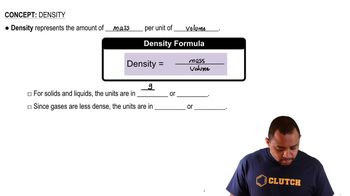
Density

Density is defined as mass per unit volume, typically expressed in grams per liter (g/L) for gases. It indicates how much mass of a substance is contained in a given volume. In this question, the density of CO2 is provided, which will be crucial for converting between mass and volume.
Video consigliato:
Percorso guidato
01:56
Density Concepts

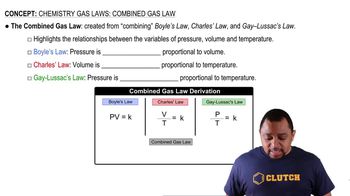
Gas Laws

Gas laws describe the behavior of gases in relation to pressure, volume, and temperature. The ideal gas law (PV=nRT) is often used to relate these variables, but in this case, we focus on density to find the volume of CO2 produced. Understanding these relationships is essential for solving problems involving gas volumes.
Video consigliato:
Percorso guidato
01:43
Combined Gas Law

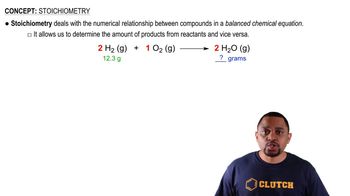
Stoichiometry

Stoichiometry involves the calculation of reactants and products in chemical reactions based on balanced equations. It allows us to determine the amount of gas produced from a given reaction. In this context, knowing the amount of CO2 produced will require stoichiometric relationships from the reaction that generated it.
Video consigliato:
Percorso guidato
01:16
Stoichiometry Concept
Pratica correlata
Domanda del libro di testo
Four solutions are prepared and mixed in the following order: (a) Start with 100.0 mL of 0.100 M BaCl2 (b) Add 50.0 mL of 0.100 M AgNO3 (c) Add 50.0 mL of 0.100 M H2SO4 (d) Add 250.0 mL of 0.100 M NH3. Write an equation for any reaction that occurs after each step, and calculate the concentrations of Ba2+, Cl-, NO3-, NH3, and NH4+ in the final solution, assuming that all reactions go to completion.
840
views
Domanda del libro di testo

Compound X contains only the elements C, H, O, and S. A 5.00 g sample undergoes complete combustion to give 4.83 g of CO2, 1.48 g of H2O, and a certain amount of SO2 that is further oxidized to SO3 and dissolved in water to form sulfuric acid, H2SO4. On titration of the H2SO4, 109.8 mL of 1.00 M NaOH is needed for complete reaction. (Both H atoms in sulfuric acid are acidic and react with NaOH.) (a) What is the empirical formula of X?

628
views
Domanda del libro di testo

Element M is prepared industrially by a two-step procedure according to the following (unbalanced) equations:

Assume that 0.855 g of M2O3 is submitted to the reaction sequence. When the HCl produced in step (2) is dissolved in water and titrated with 0.511 M NaOH, 144.2 mL of the NaOH solution is required to neutralize the HCl. (a) Balance both equations.

455
views
Domanda del libro di testo
Assume that you dissolve 10.0 g of a mixture of NaOH and Ba(OH)2 in 250.0 mL of water and titrate with 1.50 M hydrochloric acid. The titration is complete after 108.9 mL of the acid has been added. What is the mass in grams of each substance in the mixture?
1062
views
Domanda del libro di testo

A 1.268 g sample of a metal carbonate (MCO3) was treated with 100.00 mL of 0.1083 M sulfuric acid (H2SO4), yielding CO2 gas and an aqueous solution of the metal sulfate (MSO4). The solution was boiled to remove all the dissolved CO2 and was then titrated with 0.1241 M NaOH. A 71.02 mL volume of NaOH was required to neutralize the excess H2SO4. (a) What is the identity of the metal M?

524
views
Domanda del libro di testo

(b) When 5.00 g of X is titrated with NaOH, it is found that X has two acidic hydrogens that react with NaOH and that 54.9 mL of 1.00 M NaOH is required to completely neu-tralize the sample. What is the molecular formula of X?

434
views