Ch.4 - Reactions in Aqueous Solution
McMurry - Chemistry 8th Edition
McMurry8th EditionChemistryISBN: 9781292336145Non è quello che usi tu?Cambia libro di testo
Capitolo 4, Problema 37

Box (a) represents 1.0 mL of a solution of particles at a given concentration. Which of the boxes (b)–(d) represents 1.0 mL of the solution that results after (a) has been diluted by doubling the volume of its solvent? (a)
(b)
(c)
(d)

Guida verificata passo dopo passo
1
Step 1: Understand the concept of dilution. Dilution involves adding more solvent to a solution, which decreases the concentration of the solute. The total amount of solute remains the same, but it is spread out over a larger volume.
Step 2: Identify the initial conditions. Box (a) represents 1.0 mL of a solution at a certain concentration. This is your starting point before dilution.
Step 3: Determine the effect of doubling the volume. Doubling the volume of the solvent means the final volume will be 2.0 mL. The concentration of the solution will be halved because the same amount of solute is now in a larger volume.
Step 4: Visualize the particle distribution. In the diluted solution, the particles will be more spread out compared to the original solution in box (a).
Step 5: Compare the options. Look at boxes (b), (c), and (d) to identify which one shows particles that are half as concentrated as in box (a), indicating the correct representation of the diluted solution.

Risposta video verificata per un problema simile:

Questa soluzione video è stata consigliata dai nostri tutor come utile per risolvere questo problema.
Durata del video:
2m

Concetti chiave

Ecco i concetti essenziali che devi comprendere per rispondere correttamente alla domanda.

Dilution

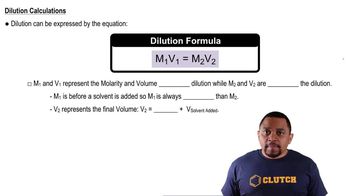
Dilution is the process of reducing the concentration of a solute in a solution, typically by adding more solvent. When a solution is diluted, the number of solute particles remains the same, but the total volume increases, leading to a lower concentration. For example, if you have 1.0 mL of a solution and you double the volume by adding 1.0 mL of solvent, the concentration of the solute is halved.
Video consigliato:
Percorso guidato
00:58
Dilution Equation

Concentration

Concentration refers to the amount of solute present in a given volume of solution. It is often expressed in units such as molarity (moles per liter) or mass/volume percent. Understanding concentration is crucial for predicting how changes in volume, such as dilution, will affect the properties of the solution, including its reactivity and behavior in chemical reactions.
Video consigliato:
Percorso guidato
07:35
Calculate Concentration of the Basic Form

Volume and Solvent Relationship

The relationship between volume and solvent in a solution is fundamental to understanding how dilution affects concentration. When the volume of solvent is increased, the solute is spread over a larger volume, which decreases its concentration. This principle is essential for solving problems related to mixing solutions and predicting the outcomes of chemical processes involving solutions.
Video consigliato:
Percorso guidato
01:09
Relationship of Volume and Moles Example
Pratica correlata
Domanda del libro di testo
The most strongly reducing elements are listed at the top of the partial activity series table provided. Use the activity series to predict which reaction will occur. (LO 4.20) (a) (b) (c) (d)

275
views

Domanda del libro di testo
Assume that an aqueous solution of a cation, represented as a red sphere, is allowed to mix with a solution of an anion, represented as a yellow sphere. Three possible outcomes are represented by boxes (1)–(3):

Which outcome corresponds to each of the following reactions? (a) 2 Na+(aq) + CO32-(aq) S (b) Ba2+(aq) + CrO42-(aq) S (c) 2 Ag+(aq) + SO32-(aq) S
590
views
Domanda del libro di testo
Identify the element that gets oxidized and the oxidizing agent in the reaction. (LO 4.19) (a) (b) (c) (d)
387
views
Domanda del libro di testo
Assume that an aqueous solution of a cation, represented as a blue sphere, is allowed to mix with a solution of an anion, repre-sented as a red sphere, and that the following result is obtained: Which combinations of cation and anion, chosen from the fol-lowing lists, are compatible with the observed results? Explain Cations: Na+, Ca2+, Ag+, Ni2+ Anions: Cl-, CO3 2-, CrO4 2-, NO3
838
views
Domanda del libro di testo
The concentration of a solution of potassium permanganate, KMnO4, can be determined by titration with a known amount of oxalic acid, H2C2O4, according to the following equation: What is the concentration of a KMnO4 solution if 22.35 mL reacts with 0.5170 g of oxalic acid? (LO 4.22) (a) 0.6423 M (b) 0.1028 M (c) 0.4161 M (d) 0.2569 M
1900
views
Domanda del libro di testo
The following pictures represent aqueous solutions of three acids HA (A = X, Y, or Z), with surrounding water mol-ecules omitted for clarity. Which of the three is the strongest acid, and which is the weakest?

625
views