
Ch.4 - Reactions in Aqueous Solution
McMurry - Chemistry 8th Edition
McMurry8th EditionChemistryISBN: 9781292336145Non è quello che usi tu?Cambia libro di testo
Capitolo 4, Problema 42a

Classify each of the following unbalanced half-reactions as either an oxidation or a reduction. (a) HClO(aq) → Cl2(g)

Guida verificata passo dopo passo
1
Identify the oxidation states of the elements in the reactants and products.
For HClO, assign oxidation states: H is +1, O is -2, and Cl is +1.
For Cl_2, assign oxidation states: each Cl is 0.
Determine the change in oxidation state for Cl: from +1 in HClO to 0 in Cl_2.
Since the oxidation state of Cl decreases, this half-reaction is a reduction.

Risposta video verificata per un problema simile:

Questa soluzione video è stata consigliata dai nostri tutor come utile per risolvere questo problema.
Durata del video:
3m

Concetti chiave

Ecco i concetti essenziali che devi comprendere per rispondere correttamente alla domanda.

Oxidation and Reduction

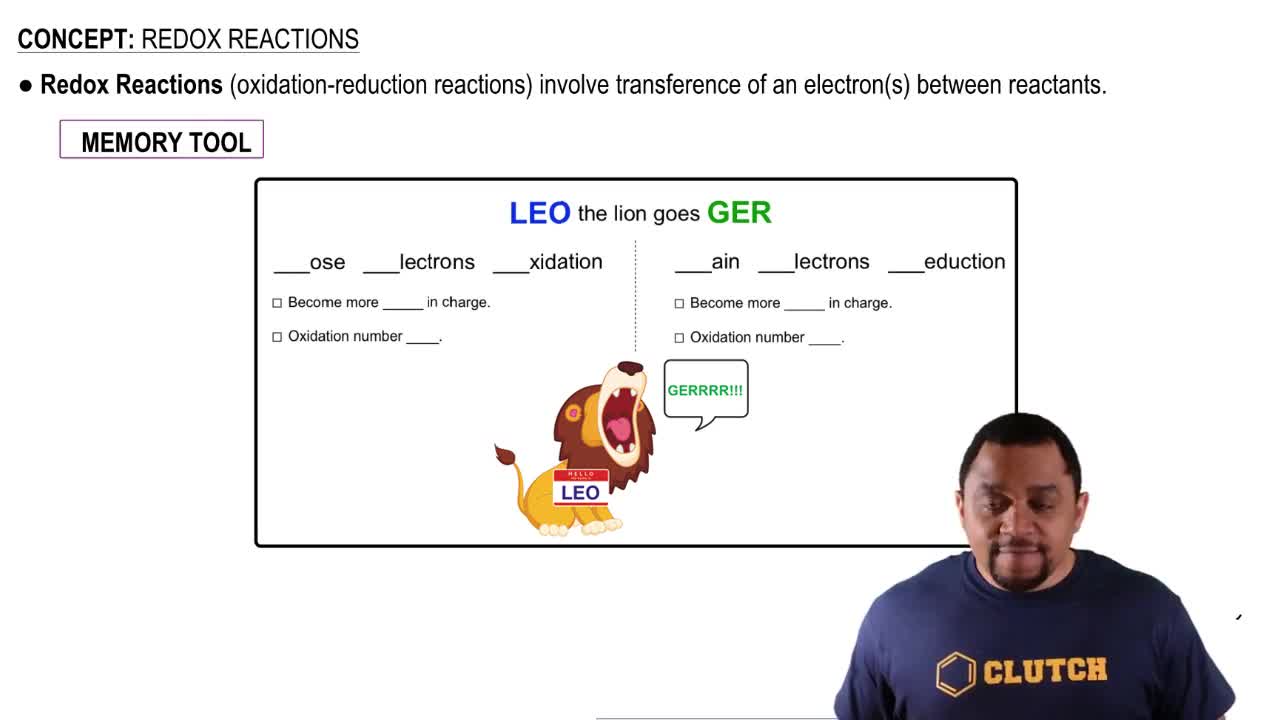
Oxidation and reduction are chemical processes that involve the transfer of electrons between substances. Oxidation refers to the loss of electrons, resulting in an increase in oxidation state, while reduction involves the gain of electrons, leading to a decrease in oxidation state. These processes are often summarized by the mnemonic 'OIL RIG' (Oxidation Is Loss, Reduction Is Gain).
Video consigliato:
Percorso guidato
01:53
Oxidation and Reduction Reactions

Oxidation States

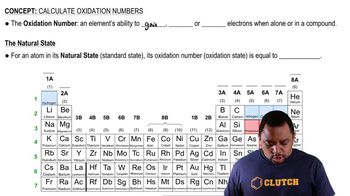
Oxidation states (or oxidation numbers) are assigned to atoms in a compound to indicate their degree of oxidation or reduction. They help in tracking electron transfer during chemical reactions. For example, in HClO, chlorine has an oxidation state of +1, which changes to 0 in Cl2, indicating that chlorine is being reduced as it gains electrons.
Video consigliato:
Percorso guidato
02:42
Oxidation Numbers

Half-Reactions

Half-reactions are equations that show either the oxidation or reduction process separately. They are useful for balancing redox reactions and understanding the electron transfer involved. In the given half-reaction, identifying whether it is an oxidation or reduction helps in classifying the overall reaction and balancing it appropriately.
Video consigliato:
Percorso guidato
01:49
First-Order Half-Life
Pratica correlata
Domanda del libro di testo
Assume that an aqueous solution of OH-, represented as a blue sphere, is allowed to mix with a solution of an acid HnA, represented as a red sphere. Three possible outcomes are depicted by boxes (1)–(3), where the green spheres represent An-, the anion of the acid: Which outcome corresponds to each of the following reactions? (a) (b) (c)
540
views
Domanda del libro di testo
The concentration of an aqueous solution of NaOCl (sodium hypochlorite; the active ingredient in household bleach) can be determined by a redox titration with iodide ion in acidic solution:

Assume that the blue spheres in the buret represent I-ions, the red spheres in the flask represent OCl-ions, the con-centration of the I-ions in the buret is 0.120 M, and the volumes in the buret and the flask are identical. What is the concentration of NaOCl in the flask? What percentage of the I-solution in the buret must be added to the flask to react with all the OCl-ions?

1051
views
Domanda del libro di testo

Classify each of the following unbalanced half-reactions as either an oxidation or a reduction. (d) SbCl4-(aq) → SbCl6-(aq)

500
views
Domanda del libro di testo

Based on the positions in the periodic table, which of the following reactions would you expect to occur? (a) Red+ + Green → Red + Green+ (b) Blue + Green+ → Blue+ + Green (c) Red + Blue+ → Red+ + Blue

411
views
Domanda del libro di testo
The following pictures represent aqueous solutions of three acids HA (A = X, Y, or Z), with surrounding water mol-ecules omitted for clarity. Which of the three is the strongest acid, and which is the weakest?

625
views
Domanda del libro di testo

Assume that the electrical conductivity of a solution depends on the total concentration of dissolved ions and that you measure the conductivity of three different solutions while carrying out titration procedures: (a) Begin with 1.00 L of 0.100 M KCl, and titrate by adding 0.100 M AgNO3. (b) Begin with 1.00 L of 0.100 M HF, and titrate by adding 0.100 M KOH. (c) Begin with 1.00 L of 0.100 M BaCl2, and titrate by adding 0.100 M Na2SO4. Which of the following graphs corresponds to which titration?

617
views