Ch.4 - Reactions in Aqueous Solution
McMurry - Chemistry 8th Edition
McMurry8th EditionChemistryISBN: 9781292336145Non è quello che usi tu?Cambia libro di testo
Capitolo 4, Problema 155a

Sodium nitrite, NaNO2, is frequently added to processed meats as a preservative. The amount of nitrite ion in a sample can be determined by acidifying to form nitrous acid (HNO2), letting the nitrous acid react with an excess of iodide ion, and then titrating the I3 - ion that results with thiosulfate solution in the presence of a starch indicator. The unbalanced equations are (1) (2) (a) Balance the two redox equations.

Guida verificata passo dopo passo
1
Identify the oxidation and reduction half-reactions in each equation.
For each half-reaction, balance all elements except for oxygen and hydrogen.
Balance the oxygen atoms by adding water (H2O) molecules to the side that needs oxygen.
Balance the hydrogen atoms by adding hydrogen ions (H+) to the side that needs hydrogen.
Balance the charge of each half-reaction by adding electrons (e-) to the more positive side.

Risposta video verificata per un problema simile:

Questa soluzione video è stata consigliata dai nostri tutor come utile per risolvere questo problema.
Durata del video:
11m

Concetti chiave

Ecco i concetti essenziali che devi comprendere per rispondere correttamente alla domanda.

Redox Reactions

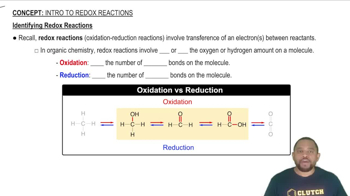
Redox reactions, or reduction-oxidation reactions, involve the transfer of electrons between two species. In these reactions, one species is oxidized (loses electrons) while another is reduced (gains electrons). Understanding the oxidation states of the elements involved is crucial for balancing redox equations, as it helps identify which species undergo oxidation and reduction.
Video consigliato:
Percorso guidato
03:12
Identifying Redox Reactions

Balancing Chemical Equations

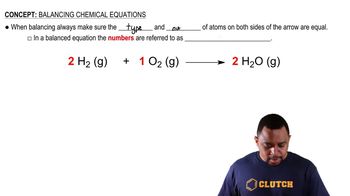
Balancing chemical equations is the process of ensuring that the number of atoms for each element is the same on both sides of the equation. This is essential for obeying the law of conservation of mass. In redox reactions, balancing often involves adjusting coefficients to account for the electrons transferred, ensuring that the total charge and mass are conserved.
Video consigliato:
Percorso guidato
01:32
Balancing Chemical Equations

Titration and Indicators

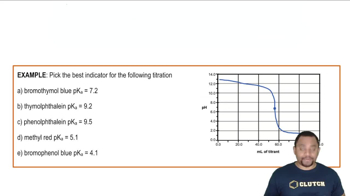
Titration is a quantitative analytical method used to determine the concentration of a solute in a solution. In this context, thiosulfate is used to titrate the iodine species formed from the reaction of nitrous acid with iodide ions. A starch indicator is employed to signal the endpoint of the titration, changing color when all iodine has reacted, which is critical for accurate measurement of the nitrite concentration.
Video consigliato:
Percorso guidato
00:52
Best Indicator Example
Pratica correlata
Domanda del libro di testo
Four solutions are prepared and mixed in the following order: (a) Start with 100.0 mL of 0.100 M BaCl2 (b) Add 50.0 mL of 0.100 M AgNO3 (c) Add 50.0 mL of 0.100 M H2SO4 (d) Add 250.0 mL of 0.100 M NH3. Write an equation for any reaction that occurs after each step, and calculate the concentrations of Ba2+, Cl-, NO3-, NH3, and NH4+ in the final solution, assuming that all reactions go to completion.
840
views
Domanda del libro di testo

To 100.0 mL of a solution that contains 0.120 M Cr(NO3)2 and 0.500 M HNO3 is added to 20.0 mL of 0.250 M K2Cr2O7. The dichromate and chromium(II) ions react to give chromium(III) ions. (a) Write a balanced net ionic equation for the reaction.

477
views
Domanda del libro di testo

(b) When a brass sample with a mass of 0.544 g was sub-jected to the preceding analysis, 10.82 mL of 0.1220 M sodium thiosulfate was required for the reaction with iodine. What is the mass percent copper in the brass?

385
views
Domanda del libro di testo

Sodium nitrite, NaNO2, is frequently added to processed meats as a preservative. The amount of nitrite ion in a sample can be determined by acidifying to form nitrous acid (HNO2), letting the nitrous acid react with an excess of iodide ion, and then titrating the I3 - ion that results with thiosulfate solution in the presence of a starch indicator. The unbalanced equations are (1) (2) (b) When a nitrite-containing sample with a mass of 2.935 g was analyzed, 18.77 mL of 0.1500 M Na2S2O3 solution was needed for the reaction. What is the mass percent of NO2- ion in the sample?

592
views
Domanda del libro di testo

Brass is an approximately 4:1 alloy of copper and zinc, along with small amounts of tin, lead, and iron. The mass per-cents of copper and zinc can be determined by a procedure that begins with dissolving the brass in hot nitric acid. The resulting solution of Cu2+ and Zn2+ ions is then treated with aqueous ammonia to lower its acidity, followed by addi-tion of sodium thiocyanate (NaSCN) and sulfurous acid (H2SO3) to precipitate copper(I) thiocyanate (CuSCN). The solid CuSCN is collected, dissolved in aqueous acid, and treated with potassium iodate (KIO3) to give iodine, which is then titrated with aqueous sodium thiosulfate (Na2S2O3). The filtrate remaining after CuSCN has been removed is neutralized by addition of aqueous ammonia, and a solu-tion of diammonium hydrogen phosphate ((NH4)2HPO4) is added to yield a precipitate of zinc ammonium phosphate (ZnNH4PO4). Heating the precipitate to 900 °C converts it to zinc pyrophosphate (Zn2P2O7), which is weighed. The equations are (1) (2) (3) (4) (5) (a) Balance all equations.

843
views
Domanda del libro di testo

(b) Calculate the concentrations of all ions in the solution after reaction. Check your concentrations to make sure that the solution is electrically neutral.

847
views