
Ch.4 - Reactions in Aqueous Solution
McMurry - Chemistry 8th Edition
McMurry8th EditionChemistryISBN: 9781292336145Non è quello che usi tu?Cambia libro di testo
Capitolo 4, Problema 62

The following aqueous solutions were tested with a light bulb conductivity apparatus, as shown in Figure 4.3. What result—dark, dim, or bright—do you expect from each? (a) 0.10 M potassium chloride (b) 0.10 M methanol (c) 0.10 M acetic acidDiagram of a light bulb conductivity apparatus for testing electrolytes.

Guida verificata passo dopo passo
1
Identify the type of electrolyte for each solution: strong electrolyte, weak electrolyte, or non-electrolyte.
For 0.10 M potassium chloride (KCl), recognize that it is a strong electrolyte and will dissociate completely into K+ and Cl- ions in solution.
For 0.10 M methanol (CH3OH), recognize that it is a non-electrolyte and will not dissociate into ions in solution.
For 0.10 M acetic acid (CH3COOH), recognize that it is a weak electrolyte and will partially dissociate into CH3COO- and H+ ions in solution.
Predict the conductivity based on the type of electrolyte: strong electrolytes will result in a bright light, weak electrolytes will result in a dim light, and non-electrolytes will result in a dark light.

Risposta video verificata per un problema simile:

Questa soluzione video è stata consigliata dai nostri tutor come utile per risolvere questo problema.
Durata del video:
2m

Concetti chiave

Ecco i concetti essenziali che devi comprendere per rispondere correttamente alla domanda.

Electrolytes

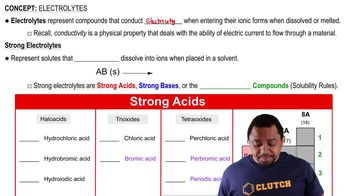
Electrolytes are substances that dissociate into ions when dissolved in water, allowing the solution to conduct electricity. Strong electrolytes, like potassium chloride, fully dissociate into ions, resulting in high conductivity. Weak electrolytes, such as acetic acid, partially dissociate, leading to lower conductivity. Non-electrolytes, like methanol, do not dissociate into ions and therefore do not conduct electricity.
Video consigliato:
Percorso guidato
02:50
Electrolytes and Strong Acids

Conductivity and Light Bulb Apparatus

The conductivity of a solution can be tested using a light bulb apparatus, where the brightness of the bulb indicates the solution's ability to conduct electricity. A bright bulb signifies a strong electrolyte with high ion concentration, while a dim bulb indicates a weak electrolyte, and a dark bulb shows a non-electrolyte. This method visually demonstrates the differences in conductivity among various solutions.
Video consigliato:
Percorso guidato
02:24
Combustion Apparatus

Concentration and Ionization

The concentration of a solution, measured in molarity (M), affects its conductivity based on the degree of ionization. A 0.10 M solution of a strong electrolyte like potassium chloride will produce a significant number of ions, enhancing conductivity. In contrast, a 0.10 M solution of a weak electrolyte like acetic acid will yield fewer ions due to partial ionization, resulting in lower conductivity. Non-electrolytes do not contribute ions, leading to no conductivity.
Video consigliato:
Percorso guidato
02:22
Auto-Ionization and Kw