Ch.4 - Reactions in Aqueous Solution
McMurry - Chemistry 8th Edition
McMurry8th EditionChemistryISBN: 9781292336145Non è quello che usi tu?Cambia libro di testo
Capitolo 4, Problema 76

Which of the following substances are likely to be soluble in water? (a) PbSO4 (b) Ba(NO3)2 (c) SnCO3 (d) (NH4)3PO4

Guida verificata passo dopo passo
1
Step 1: Understand the solubility rules. Familiarize yourself with the general solubility rules for ionic compounds in water. For example, nitrates (NO3-) and ammonium (NH4+) compounds are generally soluble, while sulfates (SO4^2-) and carbonates (CO3^2-) have exceptions.
Step 2: Analyze PbSO4. According to solubility rules, most sulfates are soluble, but lead(II) sulfate (PbSO4) is an exception and is generally insoluble in water.
Step 3: Analyze Ba(NO3)2. Nitrates are typically soluble in water without exceptions, so barium nitrate (Ba(NO3)2) is likely to be soluble.
Step 4: Analyze SnCO3. Carbonates are generally insoluble in water, except for those of alkali metals and ammonium. Tin(II) carbonate (SnCO3) is not an exception and is likely insoluble.
Step 5: Analyze (NH4)3PO4. Ammonium compounds are generally soluble in water, so ammonium phosphate ((NH4)3PO4) is likely to be soluble.

Risposta video verificata per un problema simile:

Questa soluzione video è stata consigliata dai nostri tutor come utile per risolvere questo problema.
Durata del video:
3m

Concetti chiave

Ecco i concetti essenziali che devi comprendere per rispondere correttamente alla domanda.

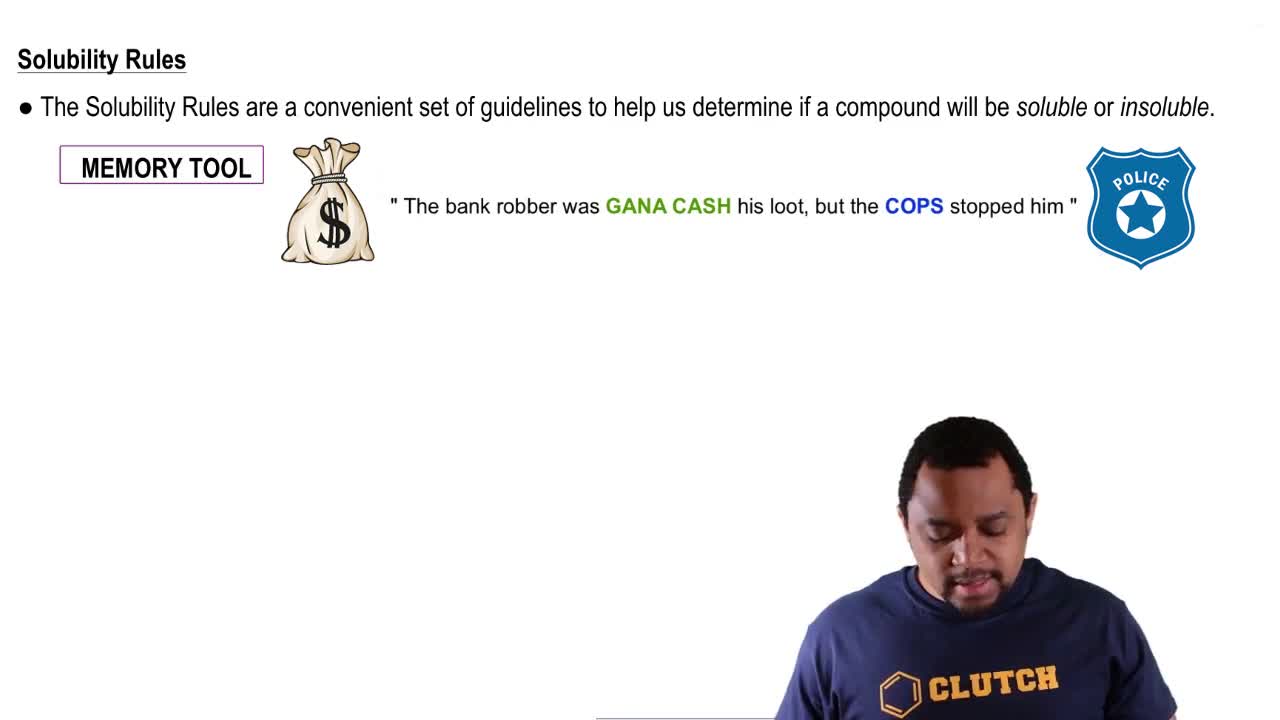
Solubility Rules

Solubility rules are guidelines that help predict whether a compound will dissolve in water. For example, most nitrates and ammonium salts are soluble, while many sulfates and carbonates have exceptions. Understanding these rules is essential for determining the solubility of various ionic compounds in aqueous solutions.
Video consigliato:
Percorso guidato
00:28
Solubility Rules

Ionic Compounds

Ionic compounds are formed from the electrostatic attraction between positively and negatively charged ions. Their solubility in water depends on the strength of these ionic bonds compared to the interactions with water molecules. Compounds with weaker ionic bonds or those that can form favorable interactions with water are more likely to be soluble.
Video consigliato:
Percorso guidato
02:11
Ionic Compounds Naming

Hydration Energy

Hydration energy refers to the energy released when ions are surrounded by water molecules. This energy can help overcome the lattice energy of ionic compounds, allowing them to dissolve. A higher hydration energy typically indicates greater solubility, as it compensates for the energy required to break the ionic bonds in the solid state.
Video consigliato:
Percorso guidato
02:04
Ionic Hydrates Naming