
Ch.5 - Periodicity & Electronic Structure of Atoms
McMurry - Chemistry 8th Edition
McMurry8th EditionChemistryISBN: 9781292336145Non è quello che usi tu?Cambia libro di testo
Capitolo 5, Problema 139c

Consider the noble gas xenon. (c) The energy required to completely remove the outermost electron from the excited xenon atom is 369 kJ/mol, almost identical to that of cesium (376 kJ/mol). Explain.

Guida verificata passo dopo passo
1
Understand that the energy required to remove an electron from an atom is known as ionization energy.
Recognize that xenon is a noble gas with a stable electron configuration, but in an excited state, it can have a similar ionization energy to cesium.
Consider that in the excited state, xenon's outermost electron is in a higher energy level, making it easier to remove, similar to cesium's outermost electron.
Note that cesium, being an alkali metal, naturally has a low ionization energy due to its single valence electron being far from the nucleus.
Conclude that the similarity in ionization energies is due to the excited state of xenon, which alters its electron configuration to resemble that of cesium.

Risposta video verificata per un problema simile:

Questa soluzione video è stata consigliata dai nostri tutor come utile per risolvere questo problema.
Durata del video:
1m

Concetti chiave

Ecco i concetti essenziali che devi comprendere per rispondere correttamente alla domanda.

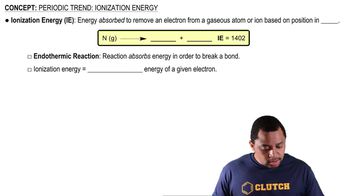
Ionization Energy

Ionization energy is the amount of energy required to remove an electron from an atom or ion in its gaseous state. It reflects the strength of the attraction between the nucleus and the outermost electron. For noble gases like xenon, the ionization energy is relatively high due to their full valence shell, while for alkali metals like cesium, it is lower due to their single valence electron being more easily removed.
Video consigliato:
Percorso guidato
01:19
Ionization Energy

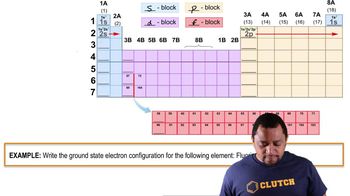
Atomic Structure and Electron Configuration

The atomic structure of an element, including its electron configuration, determines its chemical properties and reactivity. Xenon has a complete outer shell (8 electrons), making it stable, while cesium has one electron in its outermost shell. The similarities in ionization energy between xenon and cesium can be attributed to the effective nuclear charge and the distance of the outermost electron from the nucleus.
Video consigliato:
Percorso guidato
01:33
Electron Configuration Example

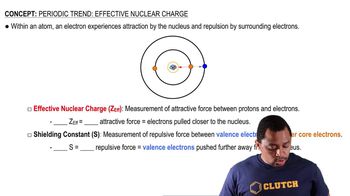
Effective Nuclear Charge

Effective nuclear charge (Z_eff) is the net positive charge experienced by an electron in a multi-electron atom. It accounts for the shielding effect of inner electrons. In the case of xenon and cesium, the effective nuclear charge influences the energy required to remove the outermost electron, leading to similar ionization energies despite their differing positions in the periodic table.
Video consigliato:
Percorso guidato
01:51
Effective Nuclear Charge