
Ch.5 - Periodicity & Electronic Structure of Atoms
McMurry - Chemistry 8th Edition
McMurry8th EditionChemistryISBN: 9781292336145Non è quello che usi tu?Cambia libro di testo
Capitolo 5, Problema 55

Cesium metal is frequently used in photoelectric cells because the amount of energy necessary to eject electrons from a cesium surface is relatively small—only 206.5 kJ/mol. What wavelength of light in nanometers does this correspond to?

Guida verificata passo dopo passo
1
Identify the energy required to eject electrons from the cesium surface, which is given as 206.5 kJ/mol.
Convert the energy from kJ/mol to J/photon. Use the conversion factor: 1 kJ = 1000 J and Avogadro's number (6.022 x 10^23 mol^-1) to find the energy per photon.
Use the equation E = h\(\nu\), where E is the energy per photon, h is Planck's constant (6.626 x 10^-34 J·s), and \(\nu\) is the frequency of the light. Rearrange the equation to solve for \(\nu\): \(\nu\) = E/h.
Use the relationship between frequency and wavelength: c = \(\lambda\)\(\nu\), where c is the speed of light (3.00 x 10^8 m/s) and \(\lambda\) is the wavelength. Rearrange to solve for \(\lambda\): \(\lambda\) = c/\(\nu\).
Convert the wavelength from meters to nanometers by multiplying by 10^9, since 1 meter = 10^9 nanometers.

Risposta video verificata per un problema simile:

Questa soluzione video è stata consigliata dai nostri tutor come utile per risolvere questo problema.
Durata del video:
2m

Concetti chiave

Ecco i concetti essenziali che devi comprendere per rispondere correttamente alla domanda.

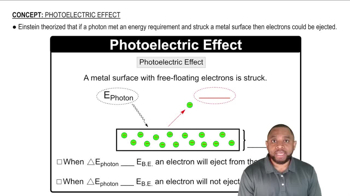
Photoelectric Effect

The photoelectric effect is the phenomenon where electrons are emitted from a material when it absorbs light of sufficient energy. This effect demonstrates the particle nature of light, where photons collide with electrons, providing them enough energy to overcome the material's work function, which is the minimum energy required to eject an electron.
Video consigliato:
Percorso guidato
02:31
Photoelectric Effect

Energy and Wavelength Relationship

The energy of a photon is inversely related to its wavelength, described by the equation E = hc/λ, where E is energy, h is Planck's constant, c is the speed of light, and λ is the wavelength. This relationship indicates that shorter wavelengths correspond to higher energy photons, which is crucial for understanding how light can cause electron ejection in the photoelectric effect.
Video consigliato:
Percorso guidato
00:31
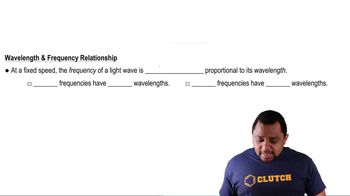
Frequency-Wavelength Relationship

Conversion of Energy Units

In this context, energy is given in kJ/mol, which must be converted to joules per photon for calculations involving individual photons. Since 1 kJ = 1000 J and 1 mol contains Avogadro's number of particles (approximately 6.022 x 10^23), converting kJ/mol to J/photon allows for the application of the energy-wavelength relationship to find the corresponding wavelength of light.
Video consigliato:
Percorso guidato
01:56
Conversion Factors
Pratica correlata
Domanda del libro di testo
Spectroscopy is a technique that uses the interaction of radiant energy with matter to identify or quantify a substance in a sample. A deuterium lamp is often used a light source in the ultraviolet region of the spectrum and the emission spectrum is shown. Is this a continuous or line emission spectrum?

635
views
Domanda del libro di testo
The work function of cesium metal is 188 kJ/mol, which corresponds to light with a wavelength of 637 nm. Which of the following will cause the smallest number of electrons to be ejected from cesium? (a) High-amplitude wave with a wavelength of 500 nm (b) Low-amplitude wave with a wavelength of 500 nm (c) High-amplitude wave with a wavelength of 650 nm (d) Low-amplitude wave with a wavelength of 650 nm
1141
views
Domanda del libro di testo
According to the equation for the Balmer line spectrum of hydrogen, a value of n = 3 gives a red spectral line at 656.3 nm, a value of n = 4 gives a green line at 486.1 nm, and a value of n = 5 gives a blue line at 434.0 nm. Calculate the energy in kilojoules per mole of the radiation corresponding to each of these spectral lines.
1660
views
1
rank
Domanda del libro di testo
Sodium-vapor lamps are a common source of lighting. The emission spectrum from this type of lamp is shown. Is this a continuous or line emission spectrum?

628
views
Domanda del libro di testo
The work function of silver metal is 436 kJ/mol. What frequency of light is needed to eject electrons from a sample of silver?
1067
views
Domanda del libro di testo
The work function of calcium metal is kJ/mol, which corresponds to light with a wavelength of 432 nm. Which of the following will cause the largest number of electrons to be ejected from cesium? (a) High-amplitude wave with a wavelength of 400 nm (b) Low-amplitude wave with a wavelength of 400 nm (c) High-amplitude wave with a wavelength of 450 nm (d) Low-amplitude wave with a wavelength of 450 nm
1171
views