Ch.5 - Periodicity & Electronic Structure of Atoms
McMurry - Chemistry 8th Edition
McMurry8th EditionChemistryISBN: 9781292336145Non è quello che usi tu?Cambia libro di testo
Capitolo 5, Problema 120

Fill in the blanks with the appropriate region of electromagnetic radiation: UV, visible, infrared. (a) The Sun most strongly emits in the _____ and regions of electromagnetic radiation (b) The atmosphere filters out biologically damaging ______ radiation from incoming solar radiation and prevents it from reaching Earth. (c) The Earth most strongly emits ______ radiation. (d) Greenhouse gases absorb _______ radiation.

Guida verificata passo dopo passo
1
(a) To determine the region of electromagnetic radiation where the Sun most strongly emits, consider the Sun's emission spectrum, which peaks in the visible region. Therefore, the Sun most strongly emits in the visible and ultraviolet (UV) regions.
(b) The atmosphere plays a crucial role in protecting life on Earth by filtering out harmful radiation. The biologically damaging radiation that the atmosphere filters out is ultraviolet (UV) radiation.
(c) The Earth emits radiation as a result of absorbing energy from the Sun. This emission is primarily in the infrared region, as the Earth is much cooler than the Sun and emits longer wavelengths.
(d) Greenhouse gases are known for their ability to absorb and re-emit infrared radiation, which contributes to the greenhouse effect and warming of the Earth's surface.

Risposta video verificata per un problema simile:

Questa soluzione video è stata consigliata dai nostri tutor come utile per risolvere questo problema.
Durata del video:
2m

Concetti chiave

Ecco i concetti essenziali che devi comprendere per rispondere correttamente alla domanda.

Electromagnetic Spectrum

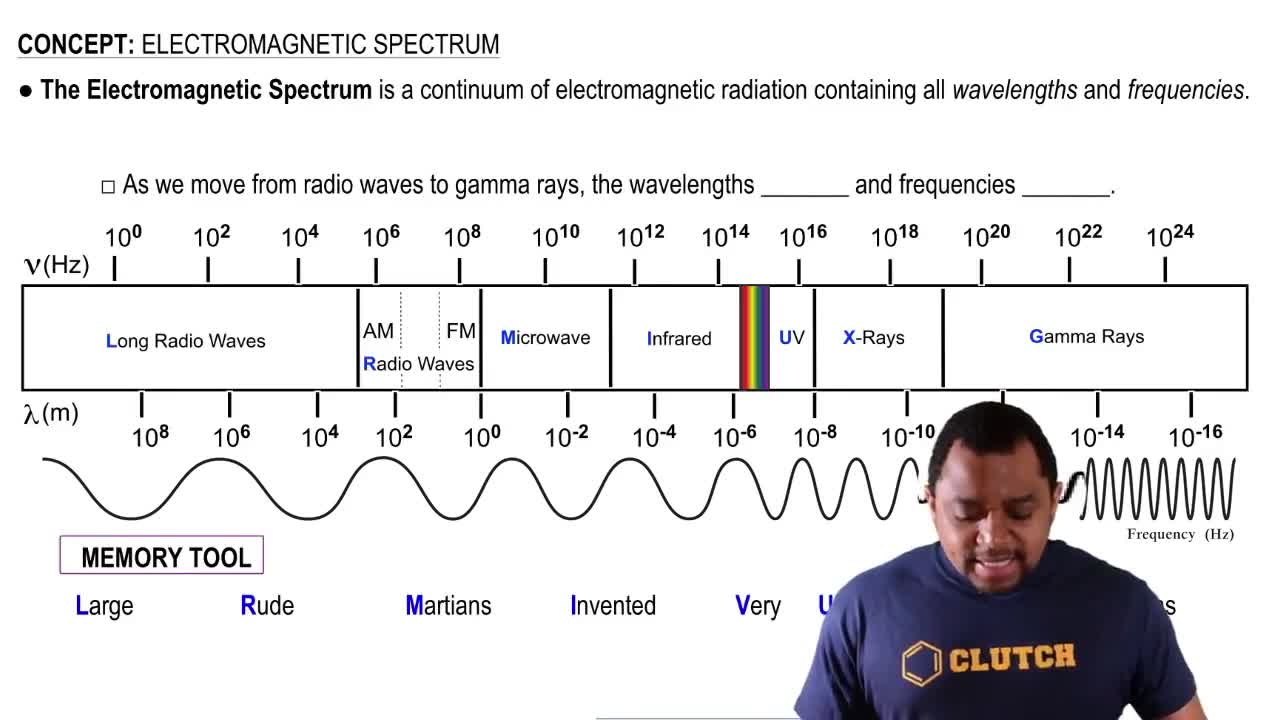
The electromagnetic spectrum encompasses all types of electromagnetic radiation, arranged by wavelength. It includes gamma rays, X-rays, ultraviolet (UV), visible light, infrared (IR), microwaves, and radio waves. Each type of radiation has distinct properties and interactions with matter, which are crucial for understanding phenomena such as solar radiation and Earth's energy balance.
Video consigliato:
Percorso guidato
02:53
Electromagnetic Spectrum

Solar Radiation

Solar radiation refers to the energy emitted by the Sun, primarily in the form of visible light, ultraviolet (UV), and infrared (IR) radiation. The Sun's peak emission occurs in the visible range, which is essential for photosynthesis and influences climate. Understanding the composition of solar radiation helps explain its effects on the Earth's atmosphere and surface.
Video consigliato:
Percorso guidato
02:52
Units of Radiation Measurement

Greenhouse Effect

The greenhouse effect is a natural process where certain gases in the Earth's atmosphere, known as greenhouse gases, trap heat. These gases absorb and re-radiate infrared radiation emitted by the Earth, preventing it from escaping into space. This process is vital for maintaining the planet's temperature but can be intensified by human activities, leading to climate change.
Video consigliato:
Percorso guidato
02:31
Photoelectric Effect